





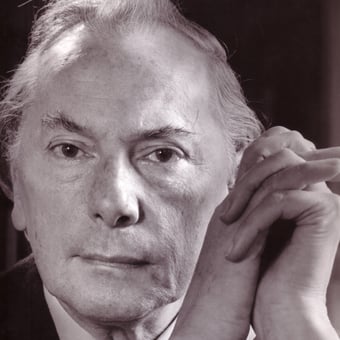
Andrzej Panufnik
Andrzej Panufnik was one of the most important Polish composers of the 20th century * Studied theory and composition at Warsaw State Conservatory, and conducting with Felix Weingartner in Vienna * During Nazi wartime occupation performed in piano duo with Witold Lutoslawski * Laid ground for future Polish avant-garde with quartertone Lullaby (1947) * Communist imposition of Socialist Realism stifled creative freedom and he escaped from Poland in 1954 * Settled in England and 'ceased to exist' in his homeland * In 1963 Sinfonia Sacra won Prince Pierre de Monaco prize and soon became most performed score * Works composed for leading performers in the West, including Sinfonia Elegiaca (Stokowski), Violin Concerto (Menuhin), Sinfonia Votiva (Ozawa) and Symphony No.10 (Solti) * In 1990 made a momentous return visit to Poland * Worklist dominated by classical genres, including ten symphonies, three string quartets, and concerti for piano, violin, bassoon and cello * Music displays craftsmanship, classical beauty, direct human expression * Economy of means with cellular construction and simple tonal or modal harmonies * Many scores explore spiritual quality of geometic and natural forms * Virtually all works available on disc, including new orchestral series on CPO
Works by Andrzej Panufnik include:
Sinfonia Sacra (1963) for orchestra
Arbor Cosmica (1983) 12 Evocations for 12 strings
Autumn Music (1962, rev.1965) for small orchestra
Violin Concerto (1971)
"The ideal is a composition in which poetic content is combined with perfection of construction... Music gets its eternal beauty from an ideal balance of emotion and intellect." — Andrzej Panufnik