


Britten, Benjamin: The Beggar's Opera op. 43 (1948) 108'
Ballad-Opera by John Gay (1728), realized from the original airs by Benjamin Britten
Music Text
Text by John Gay (E,F,G)
Scoring
S,2M,T(or Bar),T(or speaker),Bar,B,speaker; chorus 1(=picc).1(=corA).1.1-1.0.0.0-perc(1):timp/susp.cym/SD/TD/BD/tamb/ tgl/gong/wdbl-harp-strings (1.1.1.1.1)

For full details on this stagework, including synopsis and roles, please visit our Opera section.
World Premiere
5/24/1948
Arts Theatre, Cambridge
Tyrone Guthrie, director / English Opera Group / Benjamin Britten
Repertoire Note
The popularity of Britten’s three chamber operas proper (The Rape of Lucretia, Albert Herring and The Turn of the Screw) has tended to somewhat overshadow his brilliant adaptation of John Gay’s The Beggar’s Opera, the realisation of which was completed in 1948. Indeed, Britten’s harmonisations and arrangements of the pre-existing tunes, which he described as ‘among our finest national songs’, is so personal and idiosyncratic that the opera sounds like a totally original work. Despite the longish stretches of spoken dialogue, Britten brings all his usual techniques of dramatic characterisation to bear and binds the work together by effective use of leitmotif and meaningful key-schemes.
The scoring too is brilliantly imaginative with Britten varying the range and constitution of the orchestra almost from number to number. Dramatically too, the story chimes neatly with Britten’s preoccupations with the penultimate scene, where Macheath reflects on his fate in the condemned cell, remarkably foreshadowing the similar moment near the end of Britten’s next full-scale opera Billy Budd.
Reproduced by kind permission of the Britten-Pears Library
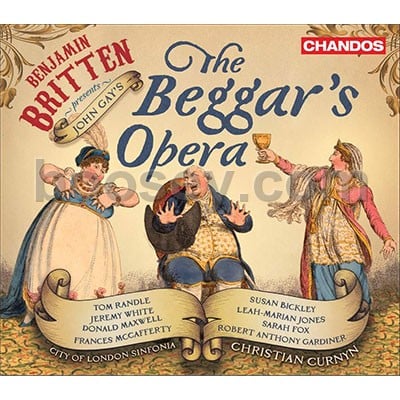
Recommended Recording
Ann Murray/Philip Langridge/Yvonne Kenny/John Rawnsley/Robert Lloyd/Anne Collins/Aldeburgh Festival Chorus and Orchestra/Steuart Bedford
Decca 436 850-2

Ballad-Opera by John Gay (1728), realized from the original airs by Benjamin Britten
Music Text
Text by John Gay (E,F,G)
Scoring
S,2M,T(or Bar),T(or speaker),Bar,B,speaker; chorus 1(=picc).1(=corA).1.1-1.0.0.0-perc(1):timp/susp.cym/SD/TD/BD/tamb/ tgl/gong/wdbl-harp-strings (1.1.1.1.1)

For full details on this stagework, including synopsis and roles, please visit our Opera section.
World Premiere
5/24/1948
Arts Theatre, Cambridge
Tyrone Guthrie, director / English Opera Group / Benjamin Britten
Repertoire Note
The popularity of Britten’s three chamber operas proper (The Rape of Lucretia, Albert Herring and The Turn of the Screw) has tended to somewhat overshadow his brilliant adaptation of John Gay’s The Beggar’s Opera, the realisation of which was completed in 1948. Indeed, Britten’s harmonisations and arrangements of the pre-existing tunes, which he described as ‘among our finest national songs’, is so personal and idiosyncratic that the opera sounds like a totally original work. Despite the longish stretches of spoken dialogue, Britten brings all his usual techniques of dramatic characterisation to bear and binds the work together by effective use of leitmotif and meaningful key-schemes.
The scoring too is brilliantly imaginative with Britten varying the range and constitution of the orchestra almost from number to number. Dramatically too, the story chimes neatly with Britten’s preoccupations with the penultimate scene, where Macheath reflects on his fate in the condemned cell, remarkably foreshadowing the similar moment near the end of Britten’s next full-scale opera Billy Budd.
Reproduced by kind permission of the Britten-Pears Library
Recommended Recording
Ann Murray/Philip Langridge/Yvonne Kenny/John Rawnsley/Robert Lloyd/Anne Collins/Aldeburgh Festival Chorus and Orchestra/Steuart Bedford
Decca 436 850-2

Mailing List
Sign up for news updates and offers via email
SIGN UPFeatured Publication
Rachmaninoff: Paganini Rhapsody
The sparkling Rhapsody on a Theme of Paganini for piano and orchestra is included in the Masterworks Library of full scores, ideal for conductors, students and music lovers.
READ MORE