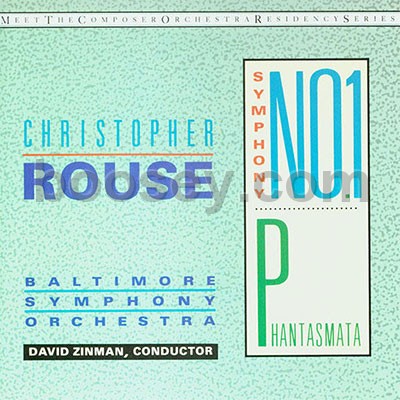


Rouse, Christopher: Symphony No.1 (1986) 24'
for orchestra
Scoring
2(II=picc).2(II=corA,ob.d'am).2(II=bcl).2(II=dbn)-4(=Wagner tubas).3.3.1-timp.perc(3):chinese cym/SD/ bongo/TD/BD/xyl/tamb/metal plate/hammer/lg tam-t/glsp/susp.cym-strings
Composer's Notes
Completed in Indianapolis, Indiana on August 26, 1986, my first symphony was composed for the Baltimore Symphony Orchestra, whose Composer-in-Residence I was from 1986 to 1988, under the auspices of the Meet the Composer Orchestra Residencies Program.
The initial impetus for the work came through the desire to use in a new context an excerpt for strings which I composed in 1976 (the music commencing at measure 219 of the symphony score). Though this music had originally been composed in response to a dream, I came to associate it with the Pieta and came to refer to it frequently by that name.
It was not until I began the actual manual composition of the symphony that I realized it to be something of a companion work to my Gorgon (1984). At first glance, however, the differences between these two scores might seem to outweigh the similarities. Gorgon is an astringently dissonant, entirely fast-paced orchestral showpiece, while the symphony is cast in the form of a single-movement adagio of considerable proportions whose overall language is largely tonal in its orientation. Both, however, are works of the blackest night, with Gorgon's exorcistic rage here replaced by a mood more somber, even tragic, in tone. Both works, moreover, concern themselves with a series of human issues which have increasingly occupied my thoughts over recent years. In a sense, Gorgon and my first symphony are a kind of yin and yang, very different responses to essentially the same stimuli.
In my Symphony No. 1 I have attempted to pay conscious homage to many of those I especially admire as composers of adagios -- Shostakovich, Sibelius, Hartmann, Pettersson, and Schuman, for example -- but only one is recognizably quoted (the famous opening theme from the second movement of Bruckner's Symphony No. 7, played both in the original and here by a quartet of Wagner Tubas). The work is scored for two flutes (2nd doubling piccolo), two oboes (2nd doubling both oboe d'amore and English horn), two clarinets (2nd doubling bass clarinet), two bassoons (2nd doubling contrabassoon), four horns (all doubling Wagner Tubas), three trumpets, three trombones, tuba, timpani, percussion (3 players), and strings. It is dedicated to my friend, John Harbison.
This programme note can be reproduced free of charge in concert programmes with the following credit line: reprinted with kind permission of Christopher Rouse
for orchestra
Scoring
2(II=picc).2(II=corA,ob.d'am).2(II=bcl).2(II=dbn)-4(=Wagner tubas).3.3.1-timp.perc(3):chinese cym/SD/ bongo/TD/BD/xyl/tamb/metal plate/hammer/lg tam-t/glsp/susp.cym-strings
Composer's Notes
Completed in Indianapolis, Indiana on August 26, 1986, my first symphony was composed for the Baltimore Symphony Orchestra, whose Composer-in-Residence I was from 1986 to 1988, under the auspices of the Meet the Composer Orchestra Residencies Program.
The initial impetus for the work came through the desire to use in a new context an excerpt for strings which I composed in 1976 (the music commencing at measure 219 of the symphony score). Though this music had originally been composed in response to a dream, I came to associate it with the Pieta and came to refer to it frequently by that name.
It was not until I began the actual manual composition of the symphony that I realized it to be something of a companion work to my Gorgon (1984). At first glance, however, the differences between these two scores might seem to outweigh the similarities. Gorgon is an astringently dissonant, entirely fast-paced orchestral showpiece, while the symphony is cast in the form of a single-movement adagio of considerable proportions whose overall language is largely tonal in its orientation. Both, however, are works of the blackest night, with Gorgon's exorcistic rage here replaced by a mood more somber, even tragic, in tone. Both works, moreover, concern themselves with a series of human issues which have increasingly occupied my thoughts over recent years. In a sense, Gorgon and my first symphony are a kind of yin and yang, very different responses to essentially the same stimuli.
In my Symphony No. 1 I have attempted to pay conscious homage to many of those I especially admire as composers of adagios -- Shostakovich, Sibelius, Hartmann, Pettersson, and Schuman, for example -- but only one is recognizably quoted (the famous opening theme from the second movement of Bruckner's Symphony No. 7, played both in the original and here by a quartet of Wagner Tubas). The work is scored for two flutes (2nd doubling piccolo), two oboes (2nd doubling both oboe d'amore and English horn), two clarinets (2nd doubling bass clarinet), two bassoons (2nd doubling contrabassoon), four horns (all doubling Wagner Tubas), three trumpets, three trombones, tuba, timpani, percussion (3 players), and strings. It is dedicated to my friend, John Harbison.
This programme note can be reproduced free of charge in concert programmes with the following credit line: reprinted with kind permission of Christopher Rouse
Mailing List
Sign up for news updates and offers via email
SIGN UPFeatured Publication
Rachmaninoff: Paganini Rhapsody
The sparkling Rhapsody on a Theme of Paganini for piano and orchestra is included in the Masterworks Library of full scores, ideal for conductors, students and music lovers.
READ MORE