


Elgar - Payne: Pomp and Circumstance March No.6 in G minor (2006) 9'
The sketches for Pomp and Circumstance March No.6 in G minor completed and orchestrated by Anthony Payne (2006)
Scoring
2.picc.2.corA.2.bcl.2.dbn-4.3.3.1-timp.perc(4):SD/cyms/BD/jingles/glsp-strings
World Premiere
8/2/2006
Royal Albert Hall, London
BBC Symphony Orchestra / Andrew Davis
Programme Note Deutsch Français
It is known that Elgar had always intended to write a set of six Pomp and Circumstance marches, but he only completed five, the first four composed during the years 1901 to 1907 and the fifth in 1930.
In 2005 Robert Montgomery, lawyer for the Elgar Will Trust, sent me a bundle of sketches for a sixth Pomp and Circumstance march, together with a 1997 Musical Times article by Elgar scholar Christopher Kent explaining their provenance. Robert wondered whether I thought there was enough material to make a completion possible. A good number of the sketches had been lodged at the British Library for some time, but they would not really have given me enough to go on had another small treasure not come to light at the Royal School of Church Music’s Colles Library – three manuscript pages, clearly in Elgar’s hand and marked ‘P&C 6’.
After an initially casual inspection I took a second look and suddenly found ideas falling into place. My interest had become fully and fascinatingly engaged. The quick-march theme in 2/4, found among the more recently discovered sketches, needed filling out texturally but could launch the main section, while a restlessly ambivalent theme in 6/8 from the British Library sketches would follow naturally on from it. The latter proved very hard to decipher and needed extending, but its highly characteristic mix of energy and wistfulness lasted for some 50 bars, helping me to give the march a unique character. Nowhere else in the Pomp and Circumstance marches does Elgar combine compound and duple metres in this way.
Elsewhere in the sketches was the beginning of a fine nobilmente trio, related to the 1924 Empire March but developed along different and more stately lines. Elgar had broken off in mid-stream, leaving the theme in the wrong key, and was obviously intending to bring it back to the home key with further eight-bar phrases. These I composed to complete a grand, arching melody. It remains to mention two short but pregnant ideas (one marked ‘jolly good’ by the composer) which I used to construct a patrol-like introduction over a marching tread. This again is not something to be found in any other of the Pomp and Circumstance marches.
It struck me that I should conclude No 6 by making a brief reference to the end of the world-famous No 1, a gesture, perhaps, of homage, celebrating the closing of a very special chapter in the composer’s creative life.
© Copyright 2007 by Anthony Payne
Reproduction Rights:
This programme note may be reproduced free of charge in concert programmes with a credit to Anthony Payne
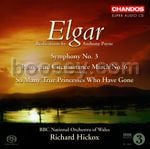
Recommended Recording
BBC National Orchestra of Wales / Richard Hickox
Chandos CHSA 5057

News stories for this title :
Elgar's sixth Pomp & Circumstance at BBC Proms
The sketches for Pomp and Circumstance March No.6 in G minor completed and orchestrated by Anthony Payne (2006)
Scoring
2.picc.2.corA.2.bcl.2.dbn-4.3.3.1-timp.perc(4):SD/cyms/BD/jingles/glsp-strings
World Premiere
8/2/2006
Royal Albert Hall, London
BBC Symphony Orchestra / Andrew Davis
Programme Note Deutsch Français
It is known that Elgar had always intended to write a set of six Pomp and Circumstance marches, but he only completed five, the first four composed during the years 1901 to 1907 and the fifth in 1930.
In 2005 Robert Montgomery, lawyer for the Elgar Will Trust, sent me a bundle of sketches for a sixth Pomp and Circumstance march, together with a 1997 Musical Times article by Elgar scholar Christopher Kent explaining their provenance. Robert wondered whether I thought there was enough material to make a completion possible. A good number of the sketches had been lodged at the British Library for some time, but they would not really have given me enough to go on had another small treasure not come to light at the Royal School of Church Music’s Colles Library – three manuscript pages, clearly in Elgar’s hand and marked ‘P&C 6’.
After an initially casual inspection I took a second look and suddenly found ideas falling into place. My interest had become fully and fascinatingly engaged. The quick-march theme in 2/4, found among the more recently discovered sketches, needed filling out texturally but could launch the main section, while a restlessly ambivalent theme in 6/8 from the British Library sketches would follow naturally on from it. The latter proved very hard to decipher and needed extending, but its highly characteristic mix of energy and wistfulness lasted for some 50 bars, helping me to give the march a unique character. Nowhere else in the Pomp and Circumstance marches does Elgar combine compound and duple metres in this way.
Elsewhere in the sketches was the beginning of a fine nobilmente trio, related to the 1924 Empire March but developed along different and more stately lines. Elgar had broken off in mid-stream, leaving the theme in the wrong key, and was obviously intending to bring it back to the home key with further eight-bar phrases. These I composed to complete a grand, arching melody. It remains to mention two short but pregnant ideas (one marked ‘jolly good’ by the composer) which I used to construct a patrol-like introduction over a marching tread. This again is not something to be found in any other of the Pomp and Circumstance marches.
It struck me that I should conclude No 6 by making a brief reference to the end of the world-famous No 1, a gesture, perhaps, of homage, celebrating the closing of a very special chapter in the composer’s creative life.
© Copyright 2007 by Anthony Payne
Reproduction Rights:
This programme note may be reproduced free of charge in concert programmes with a credit to Anthony Payne
Recommended Recording
BBC National Orchestra of Wales / Richard Hickox
Chandos CHSA 5057
Click here to purchase this CD from our online shop

News stories for this title :
Mailing List
Sign up for news updates and offers via email
SIGN UPFeatured Publication
Britten: War Requiem
Britten's pacifist masterwork, combining war poetry by Wilfred Owen with the Latin Requiem Mass, is included in the Masterworks Library of full scores, ideal for conductors, students and music lovers.
READ MORE


