


Finzi, Gerald: To a Poet op. 13 a (1921-56) 16'
Six songs for low voice and piano
Music Text
various (E)
Abbreviations (PDF).
Territory
This work is available from Boosey & Hawkes for the world.
Repertoire Note
1.To a poet a thousand years hence (Flecker) 2.On parent knees (attrib.William Jones) 3.Intrada (Traherne) 4.The birthnight (de la Mare) 5.June on Castle Hill (F.L.Lucas) 6.Ode on the rejection of St Cecilia (George Barker)
The song To a poet had a special significance for Finzi as something of an artistic credo, in which time is the ultimate and apt testimony for a creative artist. A first version was written in the 1920s, and the composer buried a copy of the song under the porch when his new house at Ashmansworth was being built, returning to revise the song in the early war years. He selected the song as one of his most satisfying creations, along with June on Castle Hill. The latter dates from the same wartime period and can be seen as a direct response to Finzi’s despairing reaction to darkening events in Europe. Intrada sets the Traherne poem that also inspired the opening orchestral movement of Dies natalis, while the Ode on the rejection of St Cecilia provided the composer with a biting modernist antithesis to his work on Blunden’s celebratory Ode to St Cecilia.
Recommended Recording
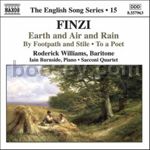
Roderick Williams (baritone)
Iain Burnside (piano) / Sacconi Quartet
Naxos 8.557963

Six songs for low voice and piano
Music Text
various (E)
Abbreviations (PDF).
Territory
This work is available from Boosey & Hawkes for the world.
Repertoire Note
1.To a poet a thousand years hence (Flecker) 2.On parent knees (attrib.William Jones) 3.Intrada (Traherne) 4.The birthnight (de la Mare) 5.June on Castle Hill (F.L.Lucas) 6.Ode on the rejection of St Cecilia (George Barker)
The song To a poet had a special significance for Finzi as something of an artistic credo, in which time is the ultimate and apt testimony for a creative artist. A first version was written in the 1920s, and the composer buried a copy of the song under the porch when his new house at Ashmansworth was being built, returning to revise the song in the early war years. He selected the song as one of his most satisfying creations, along with June on Castle Hill. The latter dates from the same wartime period and can be seen as a direct response to Finzi’s despairing reaction to darkening events in Europe. Intrada sets the Traherne poem that also inspired the opening orchestral movement of Dies natalis, while the Ode on the rejection of St Cecilia provided the composer with a biting modernist antithesis to his work on Blunden’s celebratory Ode to St Cecilia.
Recommended Recording
Roderick Williams (baritone)
Iain Burnside (piano) / Sacconi Quartet
Naxos 8.557963

Click here to purchase this CD from our online shop
Mailing List
Sign up for news updates and offers via email
SIGN UPMAXWELL DAVIES 2014
Explore the music of Peter Maxwell Davies in preparation for his 80th birthday in 2014, with audio clips and information on key works.
EXPLORE MAX