




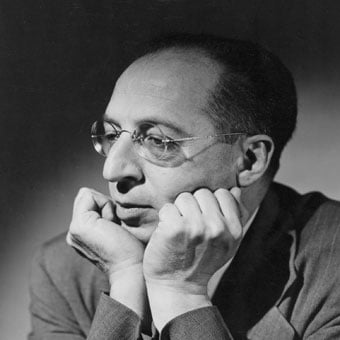
Aaron Copland
Aaron Copland is regarded as a pioneering figure in American music * While studying in Paris in 1920s was influenced by teaching of Nadia Boulanger, Stravinskian neo-classicism, popular music, and developing European nationalist composing traditions * Upon return to USA, his modernism and use of jazz gave him a reputation as an enfant terrible * In the 1930s and 40s he established a characteristically American vernacular style, employing simple harmonies, folk melodies, and lucid orchestration * Public appeal through such pieces as Fanfare for the Common Man and Old American Songs * Radical late works from 1960s such as Connotations and Inscape adopt an individualised 12-tone idiom * As conductor and educator worked tirelessly to promote other composers, at Harvard, Tanglewood, on radio and television
Works by Aaron Copland include:
Lincoln Portrait (1942) for narrator and orchestra
Appalachian Spring (1944) Ballet in one act
Symphony No.3 (1946)
The Tender Land (1952-56) Opera in three acts
Looking Ahead: Appalachian Spring (suite for full orchestra) with Baltimore Symphony Orchestra and Marin Alsop (Apr 16-19); Symphony No. 3 with The Philadelphia Orchestra and Mattias Pintscher (Apr 30-May 2)
"...he invigorated the lives of millions of ordinary music-lovers... Whether nervy or calm, harsh or homely, Copland's scores bounce, ring, vibrate and shine like nobody else's." — BBC Music Magazine