




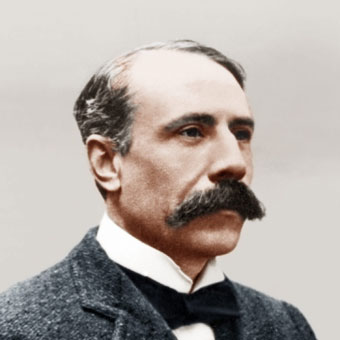
Edward Elgar
1857 - 1934
English
Deutsch
- Edward Elgar was self-taught as a composer, working first as an orchestral musician and as a violin teacher in Worcestershire.
- Gained experience as an arranger and composer, establishing a reputation in the Midlands with a series of oratorios
- Following success of Enigma Variations in 1899 his music was performed in London and throughout Europe.
- Between 1900 and 1920 regarded internationally as the leading British composer
- Influenced by Romantic composers such as Wagner, Brahms, Schumann, Liszt and Franck.
- Music explores expressive potential of chromatic harmony and virtuoso orchestration
- Originality lay largely in adoption of continental techniques, but he became viewed as a musical symbol of 'Englishness' and the Empire
- The confident, ebullient manner of his ceremonial music is contrasted with a deeper and poetic vein, demonstrating the often painful insecurities of his period, class and religion
Works by Edward Elgar include:
Sea Pictures (1897-99) Song cycle for contralto and orchestra
Cockaigne (In London Town) (1900-01) Concert Overture
Pomp and Circumstance Marches (1901-30) for orchestra
Symphony No.3 Elgar's sketches elaborated by Anthony Payne (1997)
"Music is in the air - you simply take as much as you require!" — Edward Elgar