




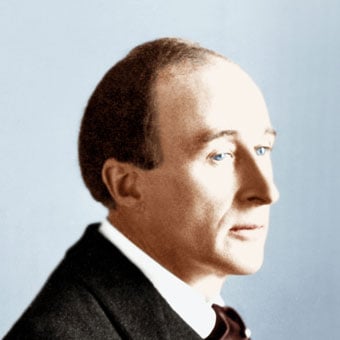
Frederick Delius
Frederick Delius rejected a career in the family business to become a composer, studying at the Leipzig Conservatoire* Early musical influences included Wagner, Chopin and Grieg * Settling in Paris in 1888 his circle included Gauguin, Strindberg and Munch * Pantheistic love of nature inspired by youthful sojourn in Florida and engagement with Scandinavian culture * Although he fostered ambitions as a stage composer, he is best remembered for his sensuous orchestral idylls * Rhapsodic style blends Impressionism and Romanticism, employing expressive harmonies and rich orchestration * From 1907 works increasingly championed by Sir Thomas Beecham, helping to establish him as a leading British composer between the wars * Blind and crippled in his later years, a series of important works were realised with assistance from his amanuensis Eric Fenby
Works by Frederick Delius include:
Appalachia (1898-1903) for baritone, chorus and orchestra
A Village Romeo and Juliet (1900-01) Lyric drama in six scenes
Sea Drift (1903-04) for baritone, chorus and orchestra
A Mass of Life (1904-05) for SATB soloists, chorus and orchestra
"...I believe myself in no doctrine whatever - and in nothing but in Nature and in the great forces of Nature..." — Frederick Delius