





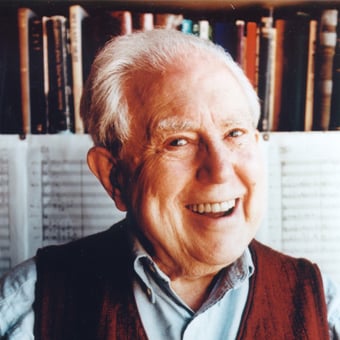
Elliott Carter
• "One of America's most distinguished creative artists in any field" (Aaron Copland)
• Awarded two Pulitzer Prizes (String Quartet No. 2, 1960; String Quartet No. 3, 1973); as well as official recognition from the governments of France, Germany, Italy, and the US
• Intricate, mercurial work often mirrors human interactions and relationships
• Music championed by leading conductors including Boulez, Barenboim, Knussen, Dohnányi, Levine, Gielen, Holliger and Morlot
• Late career creative burst yielded an outpouring of major orchestral scores and chamber works, in a style marked by clarity of texture and a new directness of formal design
Works by Elliott Carter include:
Triple Duo (1983) for chamber ensemble
Symphonia for orchestra: Partita (1993), Adagio Tenebroso (1994), Allegro Scorrevole (1996)
What Next? (1999) opera in one act
Flute Concerto (2008) for flute and ensemble
"There is often wit and humour to be heard in [Carter's] work; anger in some of the earlier big pieces; increasing lyricism and beauty in the compositions of the recent decades. He is America's great musical poet." — Andrew Porter, Musical America
“[Carter’s music is] often suffused with quiet delight, as if the Moderns’ great crisis of subjectivity might, and should, be looked on as an opportunity rather than an occasion for terrible doubt.” — Guy Dammann, Times Literary Supplement