





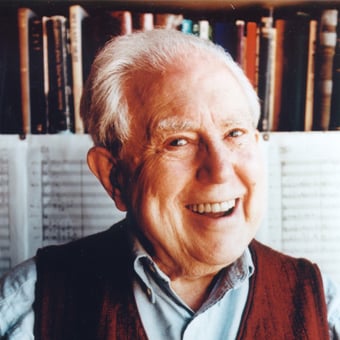
Elliott Carter
d. 5 November 2012, New York City
Short Biography:
Twice winner of the Pulitzer Prize, the first composer to receive the United States National Medal of Arts, one of the few composers ever awarded Germany's Ernst Von Siemens Music Prize, and in 1988 made "Commandeur dans l'Ordre des Arts et des Lettres" by the Government of France, as well as receiving the insignia of Commander of the Legion of Honor in 2012, Elliott Carter is internationally recognized as one America’s leading voices of the classical music tradition. He was a recipient of the Prince Pierre Foundation Music Award and was one of the few living composers to be inducted into the American Classical Music Hall of Fame during his lifetime. Carter was recognized by the Pulitzer Prize Committee for the first time in 1960 for his groundbreaking String Quartet No. 2. Igor Stravinsky hailed Carter’s Double Concerto for harpsichord, piano, and two chamber orchestras (1961) and Piano Concerto (1967), as "masterpieces."
Carter’s prolific career spanned over 75 years, with more than 150 pieces, ranging from chamber music to orchestra to opera, often marked with a sense of wit and humor. His astonishing late-career creative burst resulted in a number of brief solo and chamber works, as well as major essays such as Asko Concerto (2000) for Holland’s ASKO Ensemble. Some chamber works include What Are Years (2009), Nine by Five (2009), and Two Thoughts About the Piano (2005-06), widely toured by Pierre-Laurent Aimard. Carter showed his mastery in larger forms as well, with major contributions such as What Next? (1997–98), Boston Concerto (2002), Three Illusions for Orchestra (2004), called by the Boston Globe "surprising, inevitable, and vividly orchestrated," Flute Concerto (2008), a piano concerto, Interventions (2007), which premiered on Carter's 100th birthday concert at Carnegie Hall with James Levine, Daniel Barenboim, and the Boston Symphony Orchestra (December 11, 2008), and the song cycle A Sunbeam’s Architecture (2011).
— November 2013
This biography can be reproduced free of charge in concert programs with the following credit:
Reprinted by kind permission of Boosey & Hawkes.
Long Biography:
Composer Elliott Carter is internationally recognized as one of the most distinguished American voices in classical music, and a leading figure of modernism in the 20th and 21st centuries. He was hailed as "America’s great musical poet" by Andrew Porter and noted as "one of America’s most distinguished creative artists in any field" by his friend Aaron Copland. Carter’s prolific career spanned over 75 years, with more than 150 pieces, ranging from chamber music to orchestra to opera, often marked with a sense of wit and humor. He received numerous prestigious honors, including the prestigious Pulitzer Prize on two occasions: for his String Quartet No. 2, 1960 and String Quartet No. 3, 1973. Other awards include Germany’s Ernst Von Siemens Music Prize, and the Prince Pierre Foundation Music Award. Carter was the first composer to receive the United States National Medal of Arts, and was one of a handful of composers elected to the American Classical Music Hall of Fame. He was recognized twice by the Government of France: named Commander of the "Ordre des Arts et des Lettres", and received the insignia of Commander of the Legion of Honor in September 2012.
Born in New York City on December 11, 1908, Elliott Carter was first encouraged toward a career in classical music by his friend and mentor Charles Ives. He studied under composers Walter Piston and Gustav Holst while attending Harvard University, and later traveled to Paris, studying with Nadia Boulanger. Following his studies in France, he returned to New York, and devoted his time to composing and teaching, holding posts over the years at the Peabody Conservatory, Yale University, Cornell University, and The Juilliard School, among others.
Carter’s early works demonstrated a neoclassical style, highlighted by masterpieces such as Symphony No. 1 (1942) and Holiday Overture (1944), influenced by his contemporaries Copland, Hindemith and Stravinsky. After 1950, he shifted his compositional style away from neoclassicism and developed a unique and signature rhythmic and harmonic language, often using tempo modulation. Igor Stravinsky hailed his Double Concerto for harpsichord, piano and two chamber orchestras (1961) and Piano Concerto (1967) as "masterpieces."
Carter wrote many pieces based on literature or poetry over the span of his career, setting texts by acclaimed American authors and poets, such as John Ashberry, Elizabeth Bishop, E.E. Cummings, Robert Frost, Wallace Stevens and William Carlos Williams. A creative burst of imaginative works began in earnest during the 1980s, with works such as Night Fantasies (1980), Triple Duo (1983), Penthode (1985), and major orchestral essays such as Oboe Concerto (1986–87), Three Occasions for Orchestra (1989), Violin Concerto (1990), and Symphonia: sum fluxae pretium spei (1993–96). Carter’s only opera, What Next? (1997–98) was introduced by Daniel Barenboim, a champion of the composer’s music, in Berlin in 1999. Carter’s remarkable late-career creative burst continued at an astonishing rate, with more than 60 works coming after the age of 90, with major additions to the modern repertoire, including his Cello Concerto (2000), Of Rewaking (2002), Dialogues (2003), Three Illusions for Orchestra (2004), Mosaic (2004) and In the Distances of Sleep (2006).
Carter celebrated his 100th birthday in 2008, a year marked with salutes and tributes at concert venues and music festivals around the globe. On the occasion of his birthday, New York’s Carnegie Hall presented a new work, Interventions for piano and orchestra (2007), performed by the Boston Symphony with James Levine and Daniel Barenboim.
In his final years, Carter continued to complete works with astounding frequency. His Flute Concerto (2008) was premiered by Emmanuel Pahud and the International Chamber Music Ensemble; What are Years (2009), commissioned by the Aldeburgh and Tanglewood festivals; and Concertino for Bass Clarinet and Chamber Orchestra (2009), premiered by Virgil Blackwell and Toronto’s New Music Concerts Ensemble. An all-Carter concert in honor of his 103rd birthday in December 2011 featured the world premieres of String Trio (2011) and A Sunbeam’s Architecture (2010), as well as two surprise pieces composed in the month preceding the concert: Rigmarole and Mnemosyné. Among Carter’s final works are Dialogues II (2012), a concerto for piano and orchestra dedicated to Daniel Barenboim and premiered just weeks before his passing at the age of 103, and Instances (2012) for the Seattle Symphony.
— November 2012
This biography can be reproduced free of charge in concert programs with the following credit:
Reprinted by kind permission of Boosey & Hawkes.