





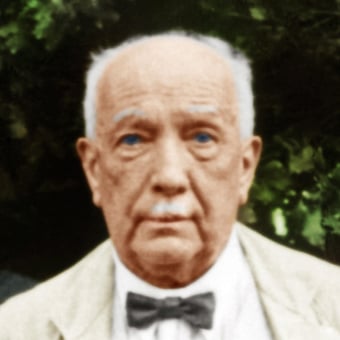
Richard Strauss
Richard Strauss was a leading post-Romantic German composer, who created many of the most widely-performed 20th century operas * Son of horn player in Munich Court Orchestra * Gained conducting experience in Meiningen and Munich, leading to appointment as Kapellmeister in Weimar * Series of tone poems in 1890s marked him as radical successor to Wagner and Liszt * Successful premieres of Salome, Elektra and Der Rosenkavalier in Dresden established him as a leading opera composer * Collaborations with poet Hugo von Hofmannsthal on six operas 1905-29 * 1910s included works ranging from commedia dell'Arte lightness of Ariadne auf Naxos to complex psychology of Die Frau ohne Schatten * Further explorations of social comedy included Intermezzo, Arabella and Die schweigsame Frau * Last decade of life brought Indian summer with operas Daphne, Die Liebe der Danae and Capriccio, the Oboe Concerto, Metamorphosen and Four Last Songs * Music combines Wagnerian richness with Mozartian lyricism * Orchestration demonstrates great virtuosity and highly original chamber-like scoring * Output includes some of the greatest writing for the female voice
Works by Richard Strauss include:
Die Frau ohne Schatten (1914-17) Opera in three acts
Metamorphosen (1944-45) for 23 solo strings, or string septet
Oboe Concerto (1945) for oboe and chamber orchestra
Four Last Songs (1948) for soprano and orchestra
"From first to last he put his trust in tonality, melody, dramatic instinct, and a vein of fantasy which belongs to all the greatest story-tellers." — Michael Kennedy