







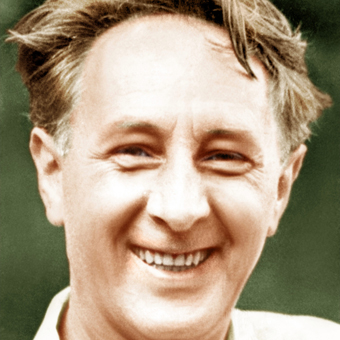

An introduction to Martinu’s music
by Patrick Lambert
With the current renewal of interest in composers who never claimed to be avant-gardists, Martinu is becoming recognised not only as one of the 20th century’s most prolific and versatile musicians, but also as one of its most independently-minded creative talents. This is not to say that during his protracted path to maturity he did not absorb a profusion of influences – French Impressionism, Stravinsky, jazz, neo-classicism and the English madrigal, in addition to his abiding love of Czech and especially Moravian folks songs. Yet, despite such multifarious influences, each and every piece is infused with his distinctive personality. Martinu himself attributed the unusual character of his music to his extraordinary birthplace in a room at the top of the church tower in the Bohemian town of Policka, where he was to spend the following 12 years of his childhood. Throughout his life he sought to recapture in sounds the ‘sense of space’ and ‘pure forms’ of Nature that had surrounded him. It was therefore perhaps inevitable that as a student in Prague he should succumb to Debussy’s music, ‘the greatest revelation’ of his life.
Martinu’s decision to seek guidance from Roussel in Paris was prompted by his desire to escape the Czech ‘cult of Smetana’ and acquire some of the qualities that he detected in French art: order, clarity, balance and refinement of taste. But the cosmopolitan Paris of the 1920s had moved on: Impressionism was dead and the scene was dominated by Les Six, jazz and especially Stravinsky, who demontrated to Martinu that folk sources could convincingly be integrated into art music. This led to a series of colourful folkloristic scores, beginning with the pantomime-ballet Spalícek. Like Stravinsky, Martinu briefly and effectively flirted with jazz, for instance in the ballet La Revue de Cuisine and the opera The Three Wishes, and due to the economic realities of the 1930s he also turned his attention towards chamber forces. Neo-classicism became the dominant influence with the 17th century concerto grosso providing the model for a series of works, several composed for Paul Sacher and his Basel Chamber Orchestra. Despite the busy, seemingly detached manner, deep emotion lurks beneath the surface, coming to the fore in the powerful Double Concerto written on the eve of the Munich Agreement, which cut the composer off from his homeland.
However, the key work of the 1930s proved to be the ‘dream opera’ Julietta, where he discarded his ‘geometrical’ neo-classical manner to explore the often irrational world of the imagination with its ‘dream-logic’ determined by fantasy. For the music associated with the elusive heroine, he devised a characteristic series of harmonic progressions, the ‘Julietta chords’, based on the Moravian cadence, which were often to reappear at significant moments in later pieces as a kind of ‘idée fixe’. The fantasy element assumed ever-increasing importance during the 1940s as he strove in the United States for ‘a new lyricism, something rather rare in modern music’. The war-time symphonies composed for American orchestras are notable for their spontaneity and organic development, the rhythmic freshness of their strongly syncopated melodies, the rare beauty of their harmony, and above all an indefinable Czech aura that suggests a latter-day Dvorák.
By the 1950s Martinu had successfully found the artistic courage and technical means to allow his fantasy unfettered expression, while retaining an almost intuitive sense of form. This approach reached its zenith in large-scale scores such as the visionary Fantaisies symphoniques (Symphony No.6) and the luminous Frescoes of Piero della Francesca, where the sophisticated neo-impressionist textures anticipate aleatoric techniques and conjure up a heightened world of the imagination. Running parallel is a series of down-to-earth, folk-orientated works, deeply poignant ‘greetings home’, which display a daring simplicity and rare purity of expression. In these last years the composer began to tackle fundamental questions of human existence, though without exaggerated weightiness or sentimentality. This trend is discernible in The Greek Passion and The Epic of Gilgamesh and even in non-vocal works such as The Parables and Incantation (Piano Concerto No.4). In connection with the latter Martinu outlined a credo that seems likely to be of increasing relevance to audiences in the 21st century:
"The artist is always searching for the meaning of life, his own and that of mankind, searching for truth. A system of uncertainty has entered our daily life. The pressures of mechanisation and uniformity to which it is subject call for protest and the artist has only one means of expressing this, by music."
Patrick Lambert, 1997
(broadcaster and writer on music, with a special interest in Czech composers including Janácek and Martinu)
Bestselling Titles by Bohuslav Martinů
-
 Publisher: Boosey & HawkesIn Stock: Usually despatched within 24-48 hours$13.96
 -
 Publisher: Boosey & HawkesUsually despatched within 7-10 working days - Lead times may vary in the case of supplier shortages or delays$19.04
 -
 Publisher: Boosey & HawkesSpecial Order: Usually despatched within 20-30 working days - Lead times may vary in the case of supplier shortages or delays$26.66
 -
 Publisher: Boosey & HawkesIn Stock: Usually despatched within 24-48 hours$66.04
 -
 Publisher: Boosey & HawkesUsually despatched within 7-10 working days - Lead times may vary in the case of supplier shortages or delays$51.44
 -
 Publisher: Bärenreiter PrahaUsually despatched within 7-10 working days - Lead times may vary in the case of supplier shortages or delays$28.58$27.15
