







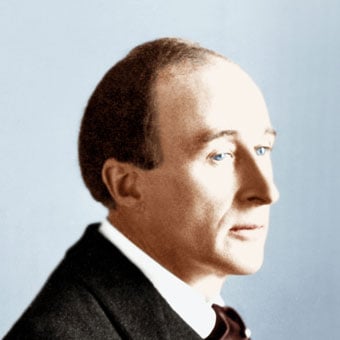

An introduction to the music of Delius
by Robert Cowan
If one had to single out a work which best expresses the full range of Frederick Delius’s art, it would be his rhapsody for baritone, chorus and orchestra, Sea Drift. The subject of Walt Whitman’s poem is love, loss and longing, and the listener experiences the bird’s endless waiting for his lost mate as if it were a potent slice of personal biography. Delius taps a vein of universal feeling, holding the attention with music that is both resilient and infinitely touching. As with other masterpieces in which words and music are perfectly matched, one is left changed and humbled. No mere "musical hedonist" could have achieved half as much.
Indeed, the clichés which have adhered to Delius’s music over the years – not only "musical hedonist", but also "mere miniatuarist " and "escapist tone poet" – have done an injustice to an oeuvre that is far broader in scope than a casual observer might imagine. Delius could, and often did, storm the heavens with unprecedented boldness. Take the opening of the second half of his pantheistic choral masterpiece A Mass of Life, where the composer scans a mountainous horizon before unleashing his chorus with a call to "Arise, now arise, thou glorious noon-tide". The words are Nietzsche’s, the spirit drunk on brave self-overcoming. Though the warm embrace of such exquisite tone poems as A Song before Sunrise, Summer night on the river or On hearing the first cuckoo in Spring will continue to serve as accompaniments to our tenderest dreams, many other works demonstrate a contrasting forward momentum and physical engagement, not least the Wagnerian drive of episodes in the opera A Village Romeo and Juliet.
It would be hard to deny Delius’s gifts as an inspired miniaturist who, like his idol Grieg, had the rare ability to capture a precise mood in music through an acute observation of nature, but his training at the Leipzig Conservatory also equipped him with craftsmanship to work on the largest of canvases with the richest palette of colours to match. His orchestral output includes two masterly sets of variations, Appalachia and Brigg Fair, based on a Lincolnshire folk song that he learned from Percy Grainger. Brigg Fair combines fantasy with formal ingenuity, softening around its centre for a floating episode that suspends time and serves as one of the most memorable passages in all of his output. Later works were mostly dictated to the amanuensis Eric Fenby, with A Song of Summer (first performed in 1931, while the blind composer listened in on the radio) rating among the finest. Delius’s instrumental oeuvre is crowned by three memorable violin sonatas, but ultimately one returns most to those works involving the human voice, including the operas which were so close to the composer’s heart and still stand to receive their full critical due.
Robert Cowan, 1998
(Music journalist for the BBC and Gramophone)
Bestselling Titles by Frederick Delius
-
 Publisher: Boosey & HawkesUsually despatched within 7-10 working days - Lead times may vary in the case of supplier shortages or delays$7.61
 -
 Publisher: Boosey & HawkesUsually despatched within 7-10 working days - Lead times may vary in the case of supplier shortages or delays$19.69
 -
 Publisher: Boosey & HawkesUsually despatched within 7-10 working days - Lead times may vary in the case of supplier shortages or delays$26.66
 -
 Publisher: Boosey & HawkesUsually despatched within 7-10 working days - Lead times may vary in the case of supplier shortages or delays$25.39
 -
 Publisher: Boosey & HawkesUsually despatched within 7-10 working days - Lead times may vary in the case of supplier shortages or delays$19.69
 -
 Publisher: Boosey & HawkesIn Stock: Usually despatched within 24-48 hours$13.96
