







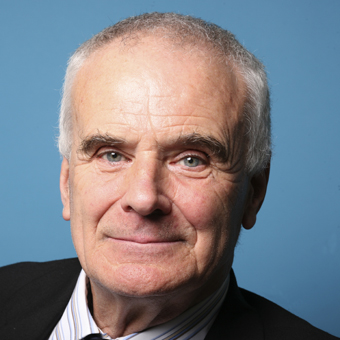

An introduction to the music of Maxwell Davies
by Paul Driver
Peter Maxwell Davies is one of Britain’s most fecund and fascinating composers, a leading member of a generation of composers for whom the twelve-tone technique of Schoenberg held no fears and demanded no slavish adherence. Davies and his fellows took a continental view of modern music with an easy and assertive confidence that marked a decisive shutting of the cattle-gate on the Vaughan Williams-influenced pastoralism prevalent in British music up until the 1950s.
For Davies, the Schoenbergian approach was crucially enriched and personalized by what he peceived as its link with medieval methods of systematically deriving a musical work from lengths of plainchant. He saw comparably stimulating connections between medieval music’s rhythmic structure and that of the Indian ragas on which he wrote his university thesis. Thus he carved out his own creative path; and the subjection of emblematic plainsong fragments to quasi-serial permutation and elaborate ‘isorhythmic’ patterning gave him not only those rigorously made, texturally austere early pieces like the Five Motets (1959), but allowed luminously lyrical statements such as the cantata Leopardi Fragments (1962); and has been the basis, indeed, of virtually every work he has written.
Maxwell Davies quickly found himself at the head of a new British avant-garde: a shocker but clearly a figure of the utmost artistic seriousness. The seriousness was most evident in big, broodingly neo-expressionist scores, sometimes with a surprisingly Mahlerian hue, like the orchestral Second Fantasia on John Taverner’s ‘In Nomine’ (1964) and Worldes Blis, a ‘motet’ for large orchestra on a 13th century English monody (1969); as of course in the complex opera Taverner (1970), about the life and conscience of the eponymous English composer.
The shocker came into his own in a series of brilliant, flamboyant music-theatre pieces. In Eight Songs for a Mad King for male voice and ensemble or the chamber ballet Vesalii Icones (both 1969), the thematic transformation process erupts at climaxes into wicked parody. Plainsongs flare up into foxtrots; and the acid of betrayal runs down the score even as it burns into the subject matter.
Betrayal – religious, artistic, personal – was the abiding expressionistic theme of Davies’s works, often written at a white heat of inspiration, during the 1960s and early 1970s. But a more calmly classicising impulse gradually took him over; and with the achievement of his first symphony (1976) – an intriguingly intricate and ambitious work, over 50 minutes long – the way was clear for a long-term exploration and reinterpretation (in Davies’s own plainsong terms) of classical sonata form and its accompanying tonal functions.
After years of copious production for his chamber ensemble The Fires of London, Davies now preferred to write chiefly for large or small orchestra: three more symphonies followed, a Trumpet Concerto, and the near-completed series of ten Strathclyde Concertos, each featuring one or more of the principals of the Scottish Chamber Orchestra, with which Davies has formed a close bond as composer-conductor.
The exigencies of regular orchestral conducting are reflected in the simpler rhythms and textures of Davies’s later orchestral works. There are, of course, important continuities: his manner of pacing and paragraphing, his fondness for plainly functional orchestral colours (sombre, suspenseful strings, declamatory drumstrokes!), remain more or less constant. But the wilder gambits of pieces like the ‘foxtrot for orchestra’, St Thomas Wake (1968), or Worldes Blis have been supplanted by the constituents of a remarkable evocation of the Orcadian landscapes in which Davies has made his home since the early 1970s. From the vocal-orchestral Stone Litany (1973) to the recent spate of concertos, his orchestral music is permeated by the cries of gulls, echoes of Scottish folk-tunes, and the thrashings of the North Sea.
During this period of Davies’s development, mainly devoted to abstract symphonic writing, the tutelary influence of Mahler has perhaps been replaced by that of Sibelius. Of course, Davies remains very much his own man, pursuing his high creative ambitions with an extremely distinctive language and vocabulary; composing as prolifically as ever; and, albeit in a quieter formal register, as daringly as ever.
Paul Driver, 1993
Bestselling Titles by Peter Maxwell Davies
-
 Publisher: Boosey & HawkesIn Stock: Usually despatched within 24-48 hours$13.34
 -
 Publisher: Boosey & HawkesUsually despatched within 7-10 working days - Lead times may vary in the case of supplier shortages or delays$3.49
 -
 Publisher: Boosey & HawkesIn Stock: Usually despatched within 24-48 hours$12.69
 -
 Publisher: Boosey & HawkesUsually despatched within 7-10 working days - Lead times may vary in the case of supplier shortages or delays$28.58
 -
 Publisher: Boosey & HawkesUsually despatched within 7-10 working days - Lead times may vary in the case of supplier shortages or delays$34.28
 -
 Publisher: Boosey & HawkesIn Stock: Usually despatched within 24-48 hours$28.58
