







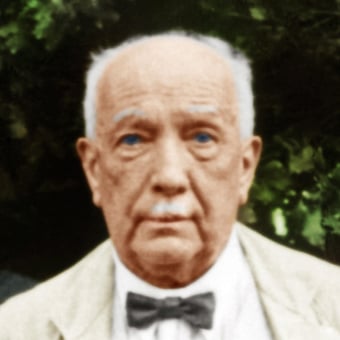

An introduction to Richard Strauss’s music
by David Nice
‘Richard the Third’ he may have been in his youth – Hans von Bülow accorded him this title because there could be no ‘second’ after Richard Wagner – but Richard Strauss was destined to become a leader, not a follower. Only a pioneer could have inspired a genius of the younger generation to become a composer through the sheer vertiginous force of a single score, as was the case with Bartók after hearing Also sprach Zarathustra in 1902, and Strauss’s influence remains far-reaching; the technical and expressive treasuries of his two most radical operas, Salome and Elektra, still have a lot to teach young composers today.
According to some of the musical history-books Strauss became a ‘retrogressive’ after the shocks of those two volcanic masterpieces in the first decade of the twentieth century. Yet only force of circumstance had turned the composer away from comedy after Salome. Hugo von Hofmannsthal, whom Strauss quickly recognised as his ideal ‘poet for music’, insisted that their first opera be based on his adaptation of Sophocles’ Electra. It was three years before Strauss was able to turn to Der Rosenkavalier and indulge to the full, and without stylistic compromise, the comic-lyric genius that was the essence of his personality, as observed by his friend and colleague Romain Rolland. Most Straussian paths lead to and from Der Rosenkavalier’s rich vein of invention; Rolland had already detected the true Bavarian humorist beneath the mock-heroics of the tone-poem Ein Heldenleben, and hymned the profound joy of its preposterously delightful successor the Symphonia Domestica.
That radiant wholesomeness also anchors the later operas, for all their psychological complexity, especially the autobiographical domestic comedy Intermezzo, the still-underrated mythologies of Daphne and Die Liebe der Danae and that increasingly popular postscript on an operatic career spent balancing the rival claims of words and music, Capriccio. It is hard to believe that the last three were written in dark times, but then Strauss always had an uncanny ability to focus single-mindedly on his musical world-within-world. He did make one bewildered response to the madness around him in the monumental Metamorphosen for 23 strings before returning to the pure instrumental forms he had preferred during his easy-going Munich youth; and in the Four Last Songs he achieved exactly the kind of quiet curtain he had stage-managed so well in many of his operas and tone poems.
It was towards the end of his life that Strauss made the off-the-cuff remark to orchestral players about being a ‘first-class second-rate composer’. Occasionally, perhaps, he was – and without shame, for all but a few of the greatest creative artists know how to turn their hand to routine commissions while major projects hang fire. Yet his musical integrity always reasserted itself. Unlike many lesser composers who felt compelled to assume new personalities to move with the times, he remained essentially true to the turn of the century in which he came to maturity; and unlike another branch of lesser composers content to repeat old formulas, he never let his sense of beauty turn to stone – no mean achievement given the upheavals through which he lived. The sentiment of which he was so proud may sometimes spill over into sentimentality, but at its best, allied to a glowing orchestral palette and a flow of melodic inspiration, his music touches on the profound; the style is certainly the man.
David Nice, 1997
(Lecturer, broadcaster and music journalist for Gramophone and BBC Music Magazine; author of short studies of Strauss, Elgar and Tchaikovsky, and Prokofieff)
Bestselling Titles by Richard Strauss
-
 Publisher: Boosey & HawkesIn Stock: Usually despatched within 24-48 hours$45.71
 -
 Publisher: Boosey & HawkesIn Stock: Usually despatched within 24-48 hours$24.77
 -
 Publisher: Boosey & HawkesIn Stock: Usually despatched within 24-48 hours$19.04
 -
 Publisher: Boosey & HawkesUsually despatched within 7-10 working days - Lead times may vary in the case of supplier shortages or delays$43.82
 -
 Publisher: Boosey & HawkesIn Stock: Usually despatched within 24-48 hours$53.98
 -
 Publisher: Boosey & HawkesIn Stock: Usually despatched within 24-48 hours$12.07
