







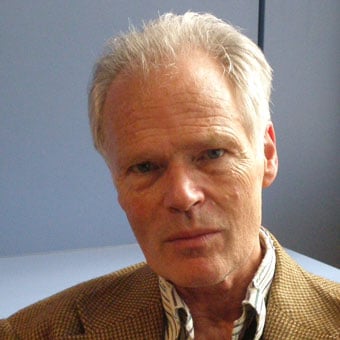

An introduction to Holloway’s music by Julian Anderson
Recent British music has largely avoided settling into predefined schools and factions, exhibiting instead a positive relish of diversity and personal idiosyncrasies. In this sense the trajectory of Robin Holloway’s output over the last thirty years, with its many detours, unexpected sidepaths and often contradictory stylistic leanings, is typical of the musical culture out of which it has grown, although the sheer persistence with which Holloway has chosen to follow up and even combine all his various musical tastes is surely unique.
As a young composer, Holloway absorbed and quickly mastered the then fashionable techniques of serial and post-serial composition in a sequence of taut, strictly composed 1960s works such as the remarkably fluent opus 1, Garden Music for nonet, the Concerto for organ and wind and the first two Concertinos. Although Holloway nowadays recalls this style somewhat dismissively as "constructivist, atonal Hindemith", this phase did produce at least one powerfully expressive piece, the First Concerto for Orchestra of 1969; part of the singular impact of that work arises from the tension already evident between rigorously consistent serially-derived techniques employed and the almost neo-Romantic abandon of the music itself, which can even incorporate massive quotations from songs by Brahms. Things eventually came to a head the following year in Scenes from Schumann, a free paraphrase on six Schumann songs in which Holloway passionately reclaimed "all that was forbidden by the Zeitgeist" – an affectionate embrace of middle-period German Romantic harmony which subjects the original material to all manner of distortion, free-association and reharmonising. This seemed to be a conscious reaction against all that his early music represented, a permanent move away from constructivism towards spontaneity and freedom of expression.
As usual with Holloway, things did not turn out to be nearly so simple. Scenes was followed by two further Schumann-derived works which expanded upon the new-found euphoniousness of that first work - the Fantasy Pieces and the large orchestral work Domination of Black, relating to the master’s Heine Liederkreis and his Kerner Lieder respectively. The latter work, indeed, shows just how far Holloway’s mastery of the orchestra had progressed since the abandonment of constructivist austerities, ranging as it does from the gossamer delicacy of the first movement, Summer Rain, to the wild rampage through late Romantic Waldmusik of the third, Night Hunt, each managed with complete fluency and self-confidence. But the work also incorporates a blackly dissonant polyrhythmic adagio (itself entitled Domination of Black) which shows that the lessons of modernism have not been forgotten, and the previous year a colourful London Sinfonietta commission entitled Evening with Angels suggested that Holloway might return to the modernist vein whilst keeping his personal harmonic style intact.
Such turned out to be the case "but now", as Holloway has commented, "the music had something behind it like harmony, direction, volatility of movement, a sense of instrumental colour." Indeed, some of Holloway’s most striking and successful achievements have been the most complex and conscientiously constructed, notably the mammoth Second Concerto for Orchestra (a richly elaborate tapestry incorporating fragments of Chopin and popular tunes English and Italian, making constructivism manifestly audible by using material familiar to all) and the recently-completed Third Concerto, an athematic essay in pure texture and possibly Holloway’s most extreme work to date.
But such achievements do not mean that Holloway has any desire to abandon his innate love of tonal harmonic practice, particularly in its late-Romantic manifestations; this side of his creative personality perhaps reaches its peak in his first opera Clarissa. Composed without commission in a single intensive compositional burst in 1976 (it was first staged at the English National Opera in 1990), this is a heart-felt personal testament vividly conveying the claustrophobic fatality of the relationship between the heroine and her would-be lover, later violator Lovelace in music of almost Bergian intensity and lushness. Holloway’s Romanticism is on equally frank display in such openly warm and immediately appealing orchestral works as Seascape and Harvest, Panorama,
the three Idylls for small orchestra and the choral-orchestral The Spacious Firmament, a valuable contribution to the British choral tradition.
Holloway has, however, shown himself eminently capable of exquisite music on the smallest scale, as evidenced in the large number of Divertimentos, Serenades and the sequence of five Concertinos. This is music written out of the sheer pleasure of composing, to be appreciated and enjoyed on the most direct levels of music-making and -loving. Indeed, ensembles looking through Holloway’s output will find therein a multitude of witty and skilful chamber pieces which will prove valuable additions to many a repertoire. Much the same might be said of the ongoing series of concertos for horn, violin, harp and other instruments, all idiomatically composed and full of capriciously unpredictable forms and turns of phrase.
If there seems to be a long way between such music and the complexities of the three Concertos for Orchestra, then one suspects that Holloway positively relishes the contrasts between his various musical manners to the extent of actually seeking to make each piece as contrasted as possible with the previous one. He himself has admitted: "One turns like a grateful plant towards all kinds of very contrasted composers who excite and please one, and pays them for what one takes in the form of a stylistic or technical homage." On closer acquaintance, however, what strikes one beyond the superficial differences of style is that the rich harmonic language, the feeling for long, arching lines and clangorous instrumental colours remain consistently characteristic of Holloway from one piece to the next; and it is this striking ability to preserve a highly individual musicality throughout this most diverse and multifarious of outputs that gives every Holloway work, large or small, constructivist or Romantic, the vivid imprint of a voice as quirkily personal as it is unmistakable.
Julian Anderson, 1995
(Composer, broadcaster and writer on music)
All quotations are taken from the interview with Holloway in Paul Griffiths’s New Sounds, New Personalities, Faber Music, 1985.
Bestselling Titles by Robin Holloway
-
 Publisher: Boosey & HawkesUsually despatched within 7-10 working days - Lead times may vary in the case of supplier shortages or delays$26.66
 -
 Publisher: Boosey & HawkesUsually despatched within 7-10 working days - Lead times may vary in the case of supplier shortages or delays$19.04
 -
 Publisher: Boosey & HawkesUsually despatched within 7-10 working days - Lead times may vary in the case of supplier shortages or delays$22.23
 -
 Publisher: Boosey & HawkesIn Stock: Usually despatched within 24-48 hours$36.82
 -
 Publisher: Boosey & HawkesUsually despatched within 7-10 working days - Lead times may vary in the case of supplier shortages or delays$25.39
 -
 Publisher: Boosey & HawkesUsually despatched within 7-10 working days - Lead times may vary in the case of supplier shortages or delays$18.42
