







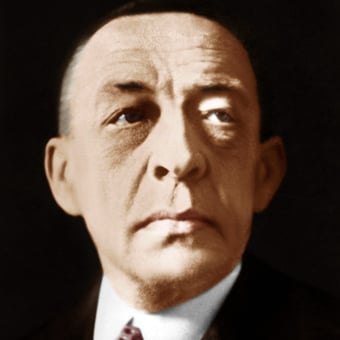

An introduction to Rachmaninoff's music
by Geoffrey Norris
As a pianist, Rachmaninoff was lionized wherever he went; as a conductor, he was praised to the skies. Yet he thought of himself first and foremost as a composer, and it is in his music that his lasting legacy lies. Although, naturally enough, he became known primarily for his piano works during his own lifetime, he transcended the traditional image of the virtuoso/composer by writing imaginatively and idiomatically in a wide variety of genres: aside from the four piano concertos, the Paganini Rhapsody and the several series of solo piano pieces, Rachmaninoff was drawn into the world of opera, to symphonies, to the choral repertory, chamber music and song.
From his student days until he left Russia in 1918, Rachmaninoff composed more or less continuously. After a conservatory education in Moscow which left him with the highest accolades anybody had ever known, he swiftly made his mark: it was not only the Prelude in C# minor that caught the public’s attention, but also his opera Aleko, a work that found particular favour with Tchaikovsky. Thereafter, Rachmaninoff broke loose from the influences of Tchaikovsky and of his teachers Arensky and Taneyev, and established his own highly individual style, based on distinctively broad, soaring melody, a harmonic succulence and, in the orchestral works, a richness tempered with the utmost discrimination in the choice and blending of instruments.
The critical mauling given to his First Symphony at its premiere in 1897 stemmed the flow of music for some three years, but the success of the Second Piano Concerto in 1901 renewed his confidence, and for almost two decades Rachmaninoff found the necessary inspiration to write the vast majority of his major works, usually while he was in the peace and quiet of his remote estate at Ivanovka, deep in the countryside to the south-east of Moscow.
This craving for tranquillity became even more pronounced after he left Russia and settled in the west: his new, hectic career as a concert performer allowed him little time to compose, but he found, in the Villa Senar, which he built on the shores of Lake Lucerne, a similar, Ivanovka-like silence in which he could conceive his late masterpieces. Throughout his music, wherever it was composed and however exuberant it may sound, there are hints of darker colours, as in his symphonic poem The Isle of the Dead, the Second Symphony or the finale of his great choral symphony The Bells. Even when Rachmaninoff’s music is apparently at its most open and passionate, there is always an intriguing, underlying strand of private emotion.
Geoffrey Norris, 1994
Bestselling Titles by Sergei Rachmaninoff
-
 Publisher: Boosey & HawkesIn Stock: Usually despatched within 24-48 hours$41.28
 -
 Publisher: Boosey & HawkesUsually despatched within 7-10 working days - Lead times may vary in the case of supplier shortages or delays$29.20
 -
 Publisher: Musica RussicaOut Of Print / Not Available / Discontinued$43.17
 -
 Publisher: Boosey & HawkesIn Stock: Usually despatched within 24-48 hours$35.55
 -
 Publisher: Boosey & HawkesIn Stock: Usually despatched within 24-48 hours$26.66
 -
 Publisher: Boosey & HawkesSpecial Order: Usually despatched within 20-30 working days - Lead times may vary in the case of supplier shortages or delays$57.79
