







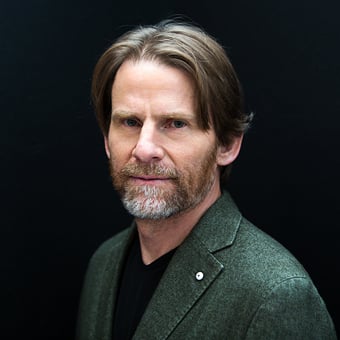

An introduction to Mackey’s music
by Frank J. Oteri
"I really think in my own music I’m mixed up at the DNA level. I’m not on any kind of conscious mission to mix these things. I really think this is how music goes, and I can’t do any other."
— Steve Mackey in conversation with Frank J. Oteri, June 13, 2005
While many people have been trying to figure out what the sonic zeitgeist of the new millennium is now that we’re thirteen years into it, it’s starting to sound like Steven Mackey has been composing 21st century music since the 1980s! The pluralistic approach of much of today’s music, where genre sanctity no longer has much sway, has pretty much been Mackey’s M.O. since his first appearance as an exciting new compositional voice on the contemporary music scene. But when he first formulated his now seminal sound world, the musical landscape was a lot different than it is nowadays.
Growing up at the same time rock matured into a musical format capable of expressing a broad range of moods and emotions, Mackey was completely smitten with its possibilities, playing electric guitar in Northern California rock bands as a teen. Sonically adventurous, he soon ventured beyond rock to explore jazz and then the blues—the music from which both jazz and rock as well as many other distinctive indigenous American musical genres sprang. At the age of 19, he discovered the European classical music tradition and became hooked on the idea of being a composer. However, when he first began seriously studying composition, he initially abandoned his electric guitar and immersed himself in the heady world of dodecaphonic music, also discovering and developing a deep passion for early music along the way. By the age of 30, he was teaching composition at Princeton University, a staunch stronghold of American serialism. But pretty soon thereafter, he started picking up his electric guitar again and in so doing began to forge a unique cross-pollination between all the music that had impacted him thus far. From hereon in, he was clearly in his own territory. And in his role at Princeton, he helped lead something akin to a velvet revolution; under his tenure it has become one of the most exciting hotbeds of an eclectic range of new music in the country.
What Mackey writes and what has emerged as a dominant aesthetic in 21st century music is not crossover, a grafting of an element of one musical style onto the trappings of another; it is much more organic than that. (Besides, in the 21st century, there’s nothing left to cross.) This is music that is a by-product of the broad range of music that emerged and continues to flourish in the United States and everywhere in the world that has had cultural interactions with the USA at this point. But this now almost seamless genetic blend of stylistic strands that were formerly designated as "high art" and "low art"—a binary that such music proves antiquated and provincial—has led to many divergent compositional paths. In Mackey’s own case, it is the result of his disparate musical immersions and his considered internalization of all of them.
For example, the aspects of rock to which Mackey’s compositional language seems most clearly indebted are not its loud raucous energy or infectious rhythmic grooves, although both are frequently components of his music as well. Rather, it’s the less obvious, sometimes under the surface details. The slides and other microtonal inflections of rock singers and guitarists resurface in Mackey’s music often in unexpected ways—a slight veering off course in an otherwise straight-forward seeming phrase in the cello solo of Banana/Dump Truck (1994) or the viola solo of Ground Swell (2006) or the entire French horn section in Pedal Tones (2002) for organ and orchestra. The subtle timbre manipulations that individual guitarists attain from carefully combining specific, often customized, equipment—amplifiers, effects units, particular kinds of strings, etc.—or that producers achieve in the studio through the use of various processors and recording techniques also have had a demonstrable influence on how Mackey revels in new sonic potentialities for the various instruments in the orchestra. Individual instrumental parts of Mackey’s scores sometimes contain detailed verbal instructions on how to produce certain sounds. Classical music players have traditionally been trained to strive for an idealized tone on their instruments, the best and cleanest possible sound that can be made. Rock musicians, on the other hand, aim to sound raw and sometimes dirty, in their quest for an instantly identifiable, personal sound. Mackey orchestrates the way these musicians mold their timbral signatures, carefully tweaking every facet to ensure a unique outcome.
A clear rock-derived element that frequently appears in Mackey’s music is the electric guitar, although he has far extended its stylistic boundaries both as a composer and as a performer. He has clearly demonstrated that the electric guitar can combine comfortably (and sometimes purposefully not so comfortably) with a symphony orchestra in Tuck and Roll (2000) and in Deal (1995) which throws in a drum set for good measure. He has also shown that an electric guitar can blend together in an ensemble with the most exalted of instrumental combinations in classical music, the string quartet—as in Troubadour Songs (1991) or Physical Property (1992), a piece initially performed by Mackey and the Kronos Quartet which probably put Mackey on the map. In his works scored exclusively for guitar ensembles—Lost and Found (1996), scored for four electric guitars, and Measures of Turbulence (2006), scored for eight of them (both acoustic and electric)—he demonstrates just how malleable and nuanced these instruments can be.
But Mackey is just as comfortable writing exclusively for instruments that are completely unplugged—he has composed a formidable Sonata for Violin and Piano (one of his only compositions ever to have a standard classical music title) in 1996 and at least nine pieces thus far for what is one of his favorite ensembles, the string quartet (most recently the JFK Assassination-themed One Red Rose (2013), plus his extremely engaging Gaggle and Flock (2001), scored for a double string quartet.) Mackey has put a particular personal stamp on another now standard ensemble, the so-called "Pierrot plus" of flute, clarinet, violin, cello, piano, and percussion—an instrumental combination that once upon a time had been associated with an extremely cerebral compositional aesthetic but which in Mackey’s hands is very exciting and fresh. While his very early 1989 Indigenous Instruments sounds like nothing else that had been heretofore written for this ubiquitous ensemble, with its surreal riffs that Mackey has described as "folk music from a culture that doesn't actually exist," the 1999 Micro-Concerto kicks it up a notch further. The percussionist is given center stage, an extremely unexpected way of handling a sextet revered in certain circles for its delicate balance of sonorities. In Five Animated Shorts (2006), he adds a Hungarian cimbalom to the sextet, adding a wine bottle, tin cans, and mixing bowls to the percussionist’s instrumentarium for good measure. Other 20th century ensemble mainstays to which Mackey has put his own 21st century compositional stamp are the percussion quartet—It Is Time (2010), written for So Percussion—and the saxophone quartet—Animal, Vegetable, Mineral (2005), written for PRISM, which exists both as a stand-alone quartet and a concerto for saxophone quartet and orchestra.
In some of Mackey’s compositions, he completely turns the tables on conventional forms, to the point that it can be extremely difficult to describe precisely what they are. Part of it undeniably comes from Mackey’s playful irreverence and tricksterish sense of humor—as in the pizza delivery that takes place in the middle of his 1993 orchestral piece Eating Greens. But part of it comes from a sincere need to shape brand new formats to tell new kinds of stories. This is perhaps most apparent in his two music theatre pieces, which are only operas in the broadest sense of the word. Ravenshead (1997)—a monodrama about a failed round-the-world voyage written with and starring Mackey’s long-term collaborator, Rinde Eckert, a performance artist with an extremely wide vocal range—is a one-of-a-kind showcase for Eckert’s unique abilities. In Slide (2009), written for Eckert and eighth blackbird, the instrumentalists also participate as actors in the story. When commissioned by the NPS (Dutch Radio) to create a work for any forces he wanted, Mackey chose to write a piece for Rinde Eckert, a vocal quartet, an electric guitar quartet and orchestra. Despite its seeming impracticalities, the resultant work—the almost psychedelic Dreamhouse (2003)—is arguably his single most remarkable composition.
But one of the most exciting aspects of Steven Mackey’s music is that it is continuing to evolve. In the past five years, he has composed some of the most profoundly moving music of his career as a result of various life-changing experiences, and a great deal of this music is within extremely conventional formats. Beautiful Passing (2008), a deeply personal response to his mother’s final illness and her acceptance of death, is a concerto for violin and orchestra in all but name, and Stumble to Grace (2011), inspired by observing his then 2½-year-old toddler, is a de-facto piano concerto albeit one with an extremely unique approach to form. At the beginning of the second decade of the 21st century, Mackey is once again leading the way, showing that the path to the music of the future does not completely reject the past, but rather incorporates elements from all eras to forge something that will ultimately be timeless.
© 2013 by Frank J. Oteri
Bestselling Titles by Steven Mackey
-
 Publisher: Boosey & HawkesUsually despatched within 7-10 working days - Lead times may vary in the case of supplier shortages or delays$24.77
 -
 Publisher: Boosey & HawkesIn Stock: Usually despatched within 24-48 hours$29.20
 -
 Publisher: Boosey & HawkesUsually despatched within 7-10 working days - Lead times may vary in the case of supplier shortages or delays$13.96
 -
 Publisher: Boosey & HawkesSpecial Order: Usually despatched within 20-30 working days - Lead times may vary in the case of supplier shortages or delays$28.58
 -
 Publisher: Boosey & HawkesIn Stock: Usually despatched within 24-48 hours$20.96
 -
 Publisher: Boosey & HawkesIn Stock: Usually despatched within 24-48 hours$22.85
