





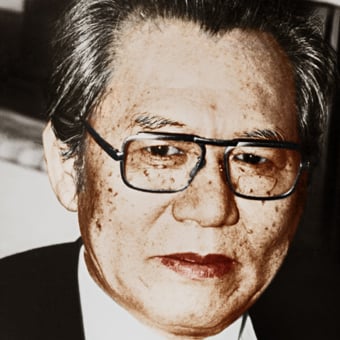
Isang Yun
Isang Yun's music successfully combines elements from East and West * Studied in Japan and Korea * Active in resistance against Japanese occupation and political prisoner in 1943 * After war worked as teacher and lecturer at University of Seoul * Studied composition in Paris in 1956, and with Blacher and Rufer in Berlin * Settled in Germany * Compositional breakthrough with premiere of orchestral work Réak at the 1966 Donaueschingen Festival * Kidnapped in 1967 by South Korean Secret Service, transported to Seoul, tortured and threatened with death * In prison composed opera Butterfly Widow on floor of cell * Following diplomatic pressure from international composing community, released to return to Germany in 1969 * Composed and taught in Hannover and at Hochschule der Künste in Berlin * In last 20 years of life concentrated on concerto form and composed 5 symphonies * Works explore aesthetic and philosophical issues relating to Asian traditional music, Chinese Taoism and Western avant-garde compositional procedures * Music informed by humanitarian concerns * Interpreters have included Heinz and Ursula Holliger, Siegfried Palm, Dietrich Fischer-Dieskau
Works by Isang Yun include:
Pièce concertante (1976) for chamber ensemble
Muak (1978) Dance fantasy for orchestra
Pezzo fantasioso (1988) for two instruments with bass instrument ad lib
Concerto for oboe and orchestra (1990)
"I was born in Korea and project that culture, but I developed musically in Europe. I don't need to organise or separate elements of the cultures. I am a unity, a simple person. It's a synthesis." — Isang Yun