





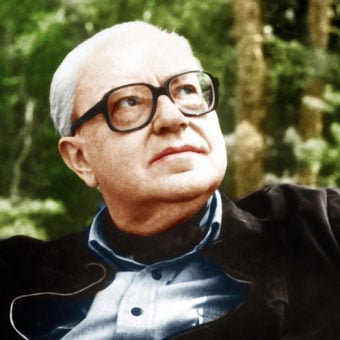
Alberto Ginastera
• Leading Argentinian composer of the 20th century
• Came to international attention in the 1940s with two ballet scores, Panambí and Estancia, employing a nationalist, folklore-influenced style
• In the early 1950s, more explicitly modernist characteristics became more pronounced in what Ginastera called his ‘neo-expressionistic period’. Late 1950s and 60s saw series of major US premieres, including Piano Concerto No.1 (Washington), Violin Concerto (New York Philharmonic/Bernstein), Harp Concerto (Philadelphia Orchestra/Ormandy) and Don Rodrigo (New York City Opera)
• Late works, in which folk influences are fully subsumed into a rich and multi-colored modern idiom, include opera Beatrix Cenci, Glosses for orchestra, Piano Concerto No.2 and two cello concertos
Works by Alberto Ginastera include:
Dances from Estancia (1941) for orchestra
Variaciones concertantes (1953) for chamber orchestra
Bomarzo (1966-67) Opera in two acts
Popul Vuh [The Creation of the Maya World] (1975-83) for orchestra
Looking Ahead: Pampeana No. 3 performed by Louisiana Philharmonic Orchestra (Oct 8); Glosses sobre temes de Pau Casals with Barcelona Symphony Orchestra and Ludovic Morlot (Nov 6-8)
"To compose, in my opinion, is to create an architecture... In music, this architecture unfolds in time... When time has past, when the work has unfolded, a sense of inner perfection survives in the spirit. Only then can one say that the composer has succeeded in creating that architecture." — Alberto Ginastera