




OPERA SEARCH

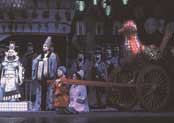
Le Rossignol
(The Nightingale) (1908-14, rev.1962)Libretto by the composer and Stepan Mitusov (R,E,F,G)
colS,S,A,T,lyrT,Bar,2B; chorus
2.picc.2.corA.3(II=Eb,III=bcl).3(III=dbn)-4.4(III=picc.tpt).3.1-timp.perc(5):cyms/
ant.cym/tgl/SD/BD/2glsp/tamb/tam-t-2harp-cel-pft-gtr-mandolin-strings
Abbreviations (PDF)
Boosey & Hawkes
Théâtre National de l'Opéra, Paris
Boris Romanov, choreographer
Conductor: Pierre Monteux
Company: Paris Opera
| NIGHTINGALE | Coloratura Soprano |
| COOK | Soprano |
| FISHERMAN | Tenor |
| EMPEROR OF CHINA | Baritone |
| CHAMBERLAIN | Bass |
| BONZE | Bass |
| DEATH | Contralto |
| JAPANESE ENVOYS | Tenor/Bass |
| Courtiers and Ghosts | chorus |
Ancient China
A humble fisherman at his nets is mesmerised by the beauty of a nightingale’s song. Rich courtiers arrive, led there by the cook who has told them of the bird’s marvellous voice. The court chamberlain tells the bird of the Chinese emperor’s desire to hear him. The nightingale agrees to return with them to the court. There, a great feast is being prepared with bustle and anxiety. The emperor appears in splendour and commands the nightingale to sing. Deeply moved by the bird’s voice, he offers rich presents, but the nightingale declares that the emperor’s tears are reward enough. A delegation from the Japanese emperor arrives with a mechanical nightingale as a gift. Seeing this, the real nightingale flies away. Angered, the Chinese emperor transfers his affections to the Japanese mechanical toy. The emperor falls sick and longs to hear the real nightingale again. The bird arrives and strikes a deal with Death. Death will spare the emperor if the nightingale sings but one more song. So he sings, dawn comes and the emperor recovers. The bird promises to return again each night.
Like The Fairy's Kiss, also inspired by Hans Christian Andersen, The Nightingale recaptures the fairy-tale world of the composer's childhood. Act I, with its plaintive Fisherman, recalls the romantically iridescent style of Rimsky-Korsakov. Acts II and III, composed some four years later, postdate The Rite of Spring; here, Stravinsky's evocation of a bizarre Chinese court, its bells and lanterns, is a sardonic phantasmagoria. The silvery arabesques and trills of the Nightingale banish Death from the Emperor's bedside. In 1917, the opera was turned into a ballet. Stravinsky: "I had been thinking of making a symphonic poem for orchestra by combining the music of Acts II and III of The Nightingale, which were homogeneous, and I told Diaghilev I would place that at his disposal if he cared to make a ballet of it. He warmly welcomed the suggestion."
Repertoire note by Joseph Horowitz
Stravinsky began work on this opera, based on the Hans Christian Anderson story, as early as 1908, but put it to one side when Diaghilev’s commission for The Firebird came along. By the time he picked it up again just four years later, he was a very different kind of composer, and an international celebrity. The modernist musical style of Acts 2 and 3, containing all sorts of magical effects, is quite different from the glistening Rimsky-influenced music of the first act; nonetheless, the two ‘parts’ fit together effectively. Memorable productions include that of Robert Lepage for Canadian Opera and the staging with David Hockney’s designs for the Metropolitan Opera. The work lasts only around 45 minutes in total so needs to be programmed with a one-act theatre work to make a full evening. It would work well with Stravinsky’s own Renard, for example . Other pairings might include staged versions of Stravinsky’s The Rite of Spring or Oedipus Rex, Ravel’s L’Heure espagnole or Tchaikovsky’s Iolanta.
Repertoire note by Jonathan Cross
Poetic

Natalie Dessay/Vsevolod Grivnov/Marie McLaughlin/Laurent Naouri/Albert Schagidullin/Maxim Mikhailov/Violeta Urmana/Olivier Berg/Wassyl Slipak/Grzegorz Staskiewicz/
Paris National Opera Chorus/Paris National Opera Orchestra/James Conlon
Warner Classics 4565002
Erato DVD 5442429