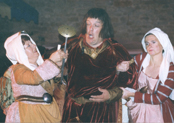


Photo: Cécile Laval
Bruniquel, 2002
Offenbach - Keck
Croquefer ou Le Dernier des paladins (OEK critical edition) (1857)
Opéra-bouffe in one act
Libretto by Adolphe Jaime and Etienne Tréfeu; new German version; new English version by Richard Duployen (F,G,E)
Scoring
S,3T,Bar;
2(II=picc).1.2.1-2.2.1.0-timp.perc-strings.
Abbreviations (PDF).
Territory
This work is available from Boosey & Hawkes for the world.
World Premiere
2/12/1857
Paris
Company: unknown
World premiere of version
8/2/2002
Bruniquel
Frank T'Hézan, director
Conductor: Jean-Christophe Keck
Company: Cie de la Tour Brunehaut
Roles
| MUNCHIRON, fearful knight | Tenor |
| FIRESTONE, his squire, stubborn servant | Tenor |
| BEAT-TO-DEATH, knight, incomplete | Baritone |
| SULPHURBLOSSOM, his daughter | Soprano |
| SKULLSMASHER, nobleman, Munchiron's nephew | Tenor |
Time and Place
Platform of a half-ruined tower. In former times
Synopsis
Munchiron, a knight of very sorrowful countenance, swallows his last remaining sabre. He will probably not need it any longer: his enemy Beat-to-Death, whose daughter Sulphurblossom he has taken away, is likely to fight only to a very limited degree, for in the battle against the unbelievers he has already lost a number of crucial body parts, among them his tongue. When Beat-to-Death nevertheless throws down the gauntlet, Munchiron's nephew Skullsmasher appears to save him. Munchiron offers Beat-to-Death two alternatives: either Sulphurblossom will be killed or she will marry him. The forced reconciliation is achieved, though it is sabotaged by subversive elements on both sides. The wine has been poisoned – accidentally with castor oil. The deployment of the troops heralds a collective bout of diarrhoea, in the course of which Munchiron's sabre and Beat-to-Death's tongue are rediscoverd. It all ends happily with the composer and his librettist sending their greetings from the lunatic asylum.
Moods
Comic
Subjects
History, Relationships, Politics, Society