







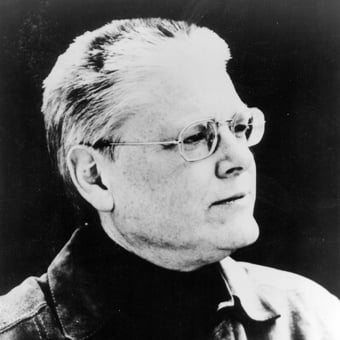

An introduction to Zender’s music
Between Calligraphy and Collage
by Martin Demmler
The experience of time and its portrayal in music within the tension between memories of things past and anticipation of things to come is the central theme of Hans Zender's thinking as a composer. The experience of all things passing, of that which is not repeatable, determines the structure of many of Zender's works but in very different ways. That his second collection of writings on music bears the title We never enter the same river twice (after Heraclitus), is not coincidental. Zender, for whom the ideas of Bernd Alois Zimmermann were an important stimulus, had already rejected the hermetism and dogmatism of serial composition in the early 1950s and, instead, had begun the search for his own language in which to realise his musical ideas of sounds in space and time.
Two main threads run through Zender's work that, at times, touch or even penetrate each other. On the one side there are the compositions where the composer reflects on the thought and ideas of far-eastern Zen philosophy, often utilising Japanese or Chinese texts. Zender is particularly fascinated by the technique of calligraphy and its traces are found in his works. The other thread in Zender's work concerns techniques and authors that stem from the Western cultural tradition. He has selected texts from the Bible, Thomas Müntzer, Meister Eckehart, Cervantes and Heraclitus, amongst others, to form the basis of his works and in his Dialog mit Haydn, for example, Zender takes a popular theme of a classical composer - but not in order to invoke a past, supposedly ideal world of music. Zender has no inhibitions concerning tradition; on the contrary, it is an essential part of his musical thinking.
For it is only against the background of tradition, with which the analytical mind of this director is very familiar, that what is new can be experienced as new at all. Moreover, a technique such as collage, which plays a seminal role in Zender's oeuvre, cannot exist without the material it assembles. The principle of multi layers, the simultaneity of many styles and time levels, is particularly evident in his first opera, Stephen Climax, where two parallel levels of action are linked to form a dazzling collage of characters and allusions.
About one half of Zender's compositions are based on texts. However, these are by no means simple musical settings accompanying the words; the literary text itself is the basic of composition. The texts are collages, distorted, translated into different languages or placed in a new context of meaning as, for example, in the chamber music cycle Hölderlin lesen where the poet's verses are recited against an imaginary language of sound in the spirit of the mature Beethoven.
Hans Zender is an exceptionally vital musician, well-educated in literature and philosophy, who continually turns new impulses to good use in his works. Whether through calligraphy or collage, the musical universe of Hans Zender encompasses a myriad of possibilities for combining structure and expression - the two basic elements of his musical thought.
Martin Demmler (© 2000)
Bestselling Titles by Hans Zender
-
-
 Publisher: Bote & BockUsually despatched within 7-10 working days - Lead times may vary in the case of supplier shortages or delays$10.15
 -
 Publisher: Bote & BockUsually despatched within 7-10 working days - Lead times may vary in the case of supplier shortages or delays$19.04
 -
 Publisher: Bote & BockUsually despatched within 7-10 working days - Lead times may vary in the case of supplier shortages or delays$43.17
 -
 Publisher: Breitkopf & HärtelIn Stock: Usually despatched within 24-48 hours$12.07
