







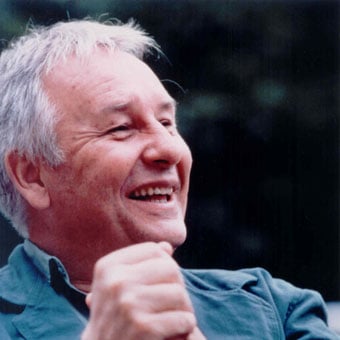
Henryk Mikolaj Górecki

After musical studies in Rybnik and Katowice, HM Górecki’s compositions first made their mark in the mid-1950s when he found himself at the forefront of the Polish avant-garde at the time of the post-Stalin cultural thaw. His early works show a clear development from the folk-influenced worlds of Szymanowski and Bartók in the Four Preludes for piano (1955) and Songs of Joy and Rhythm (1956) to the modernist techniques of Webern and Boulez in Epitafium (1958) and Symphony No.1 (1959), both premiered at the Warsaw Autumn Festival. During the 1960s Górecki continued in a radical direction in the Genesis (1962-63) and Muzyczka (1967-70) cycles of works, whilst paring down his compositional material and exploring the folk music traditions of his beloved Tatra region in such works as Three Pieces in Old Style (1963) and Muzyka staropolska (Old Polish Music) (1967-69).
The simple yet monumental style for which Górecki is today renowned became fully established in the 1970s with such works as Symphony No.2 'Copernican' (1972), the much lauded Symphony No.3 'Symphony of Sorrowful Songs' (1976) and the large-scale Psalm setting for chorus and orchestra Beatus Vir (1979). With his withdrawl from public life due to political and health pressures, the early '80s saw Górecki concentrating on choral settings and chamber music, including his trio Recitatives and Ariosos 'Lerchenmusik' (1984-85).
As a result of Poland's increasing political emancipation in the late 1980s, Górecki's music travelled more widely and attracted new performers and audiences in the West. This renewed interest led to the composition of three major string quartets, Already it is Dusk (1988), Quasi una fantasia (1991) and ...songs are sung (1995), commissioned for the Kronos Quartet. His music is today performed throughout the world including Górecki features at numerous international festivals, many choreographies to his music, and a series of highly successful recordings on the Nonesuch label.
Górecki's most noted compositions of the 1990s included Concerto-Cantata (1992) for flute and orchestra and Kleines Requiem für eine Polka (1993) recorded by both the Schoenberg Ensemble on Philips and the London Sinfonietta on Nonesuch. Górecki completed two choral works in the run up to the millennium, Salve, Sidus Polonorum (1997-2000) for chorus, percussion and keyboards, and Lobgesang (2000) for chorus and glockenspiel. At his death in 2010, works awaiting performance included Symphony No.4: Tansman Episodes (2006) premiered by the London Philharmonic Orchestra in 2014 and released on Nonesuch, the hour-long oratorio Sanctus Adalbertus (1997-8), a setting for choir and small orchestra of the Kyrie (2004-5) and Two Tristan Postludes and Chorale (2004) for orchestra.
Henryk Mikolaj Górecki is published by Boosey & Hawkes.
December 2017
This biography can be reproduced free of charge in concert programmes with the following credit: Reprinted by kind permission of Boosey & Hawkes
Bestselling Titles by Henryk Mikolaj Górecki
-
 Publisher: Boosey & HawkesIn Stock: Usually despatched within 24-48 hours$3.49
 -
-
 Publisher: Boosey & HawkesIn Stock: Usually despatched within 24-48 hours$5.72
 -
 Publisher: Boosey & HawkesUsually despatched within 7-10 working days - Lead times may vary in the case of supplier shortages or delays$10.15
 -
 Publisher: Boosey & HawkesUsually despatched within 7-10 working days - Lead times may vary in the case of supplier shortages or delays$7.61
 -
 Publisher: Boosey & HawkesUsually despatched within 7-10 working days - Lead times may vary in the case of supplier shortages or delays$3.49
