







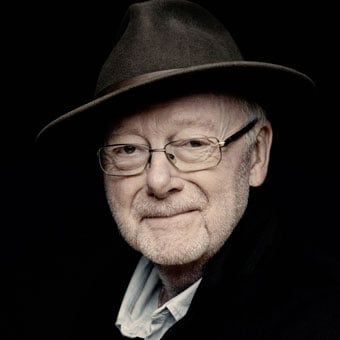

An introduction to Andriessen’s music
by Elmer Schönberger
By the age of 20, in Nocturnen, Louis Andriessen had already exhibited signs of subscribing to the Francophile inclinations for which his family, a clan of composers, had become renowned. In the years that followed, he provided through various Ittrospezioni a headstrong commentary on his experiences in the Brave New World of series and ratio, elevated stylelessness to style in the pair of Anachronie, and drew up a blueprint for his musical future in Contra tempus. It was, however, with De Staat in 1976 that Andriessen stamped an indelible mark on post-war music in Europe. Not only did De Staat mark the birth of what has since become considered the ‘true’ Louis Andriessen, but the work also fractured Dutch music into ‘pre-’ and ‘post-’. Much of what has subsequently passed for ‘typical Dutch music’ can be traced to that energising and immediately recognizable combination of pianos, harps, winds, bass guitars and close-harmony vocal groups, of bravura and monumentality, of formality and spontaneity, and of American minimalism and Dutch earthiness, which gives De Staat its idiosyncratic sound quality and dynamism.
All of these characteristics, including the application of process music techniques, the catchy melodic and harmonic material, and the chain forms rich in contrast, represent the point of departure for a quest that has taken the composer to the furthest reaches of musical and extra-musical subject matter, varying from De Tijd (Time) to De Snelheid (Velocity) and from De Materie (Matter) to TAO (The Way). The thematicising of such general notions has perpetually yielded new compositional angles – new music ‘about’ these concepts, to use a favourite Andriessen term. The typical Andriessen work is a composition rich in philosophical curiosity, one whose identity is drawn from ever-changing but always explicit choices in the area of structure and material, and from the interplay between speculative constructivism and instinctive empiricism.
But Andriessen’s oeuvre is anything but uniform. On the contrary, it spans many a genre, takes the featherweight as seriously as the profound, and is unmodernistically generous in the way it acknowledges its kinship to other musical influences, whether that ‘other’ be Stravinsky or Charlie Parker, Bach or Ives, boogie-woogie or rap. It is this open-mindedness, combined with strict discipline, which has made Andriessen a much sought-after teacher and a major influence on a generation of composers including Steve Martland, David Lang, Julia Wolfe and Cornelis de Bondt. Andriessen’s compositions manoeuvre between the extremes of violent rhetoric and pure timeless beauty, of fast-paced, loud, extroverted music as in De Stijl and unhurried, subdued and reflective music as in Hadewijch, of large-scale musical theatre as in Rosa and small-scale theatre music as in Dances. All of this is ranged in the most diverse spectrum of instrumentation, varying from a wind band (in Symphonies of the Netherlands, that light-hearted miniature De Staat) to an elegant harpsichord in the Overture to Orpheus.
The fact that works for traditional symphony orchestra are missing from his oeuvre is a direct ramification of his categorical political posture during the 1970s. His one and only ‘symphony’ has an inbuilt handicap: the Symfonie voor losse snaren – a symphony for deliberately retuned open strings. Just as this conscious choice to turn away from the symphony orchestra and embrace the idiosyncratic sound of self-made ensembles, via the founding of groups such as Hoketus and the still-active De Volharding, resulted in the typical Andriessen sound, so the ideal of a democratised musical practice took shape in the virtuosic homophony of De Staat, with its chord blocks and unison melodies that demand razor-sharp music-making.
Musical innovation is politically dangerous, according to a quartet of women’s voices singing from Plato in Andriessen’s own Politeia – that is, De Staat. Taking Brecht as a model, De Staat uses the example in order to refute it. Were it only true! If only Plato had been right, the music cries, not in the sung Greek text but in the heartfelt notes in which the words are submerged. It is an idealistic message that Louis Andriessen’s music – even if it is a message between the notes – repeats constantly and in innumerable varieties and guises, until well beyond The Last Day.
Elmer Schönberger, 1998
(musicologist, author, composer, and co-author with Andriessen of the Stravinsky study The Apollonian Clockwork)
Bestselling Titles by Louis Andriessen
-
 Publisher: Boosey & HawkesUsually despatched within 7-10 working days - Lead times may vary in the case of supplier shortages or delays$20.96
 -
 Publisher: Boosey & HawkesUsually despatched within 7-10 working days - Lead times may vary in the case of supplier shortages or delays$18.42
 -
 Publisher: Boosey & HawkesSpecial Order: Usually despatched within 20-30 working days - Lead times may vary in the case of supplier shortages or delays$93.35
 -
 Publisher: Boosey & HawkesUsually despatched within 7-10 working days - Lead times may vary in the case of supplier shortages or delays$33.01
 -
-
 Publisher: Boosey & HawkesSpecial Order: Usually despatched within 20-30 working days - Lead times may vary in the case of supplier shortages or delays$33.01
