







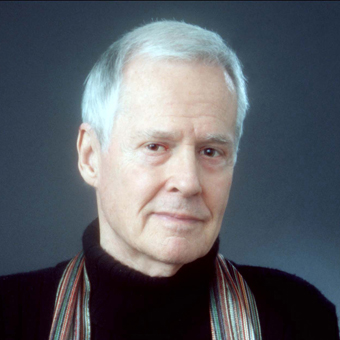

NED ROREM AT 100: 2023
An introduction to the music of Ned Rorem
by Frank J. Oteri
Ned Rorem has been hailed in Time magazine as “the world’s best composer of art songs” and the more than 500 he has composed thus far are treasured by singers, pianists, and listeners around the world. But despite his extremely prolific output in that medium, Rorem has made highly significant contributions to just about every other musical idiom as well—from intimate solo instrumental and chamber music compositions to symphonies and operas—and those contributions have garnered accolades ranging from a Grammy Award to the Pulitzer Prize.
For eight decades, Rorem has been steadfastly crafting individualistic music filled with exuberant rhythmic energy and shimmering with hauntingly beautiful melodies without any concern about passing compositional fads. As a result, the body of music he has created is now timeless. And although various places he has lived have left an indelible mark on him (the expansive fields of his native state of Indiana, the awe-inspiring skyscrapers of Chicago where he grew up, the nostalgic charm and frivolity of Paris where he spent a formative decade when he was in his 20s, and the relentless freneticism of his eventual and current home, New York City), he has forged these diverse geographical inspirations into a sound world that is universal in its scope and its humanity.
But the greatest influence on Rorem has been language, hence his lifelong devotion to crafting songs. He has put melodies and harmonies to the words of some of the most important poets from past centuries—Shakespeare, Spenser, Browning, Tennyson, Yeats, Whitman—as well as some of his own celebrated contemporaries: Frost, Cummings, Roethke, O’Hara, Ashbery, Plath, Bishop, and Gertrude Stein, to name only a few. His 1997 evening-length song cycle Evidence of Things Unseen, a magnum opus in his vocal œuvre comprising a total of 36 songs for four voices and piano, is based on texts by a total of 24 different authors. But his symbiotic fusion of music and literature reaches its culmination in his two full-length operas which are both based on classic plays and each created in collaboration with a major librettist: Miss Julie (1965, Kenward Elmslie from August Strindberg) and Our Town (2005, J. D. McClatchy from Thornton Wilder). A formidable writer in his own right, Rorem is the author of sixteen books which range from collections of poignant music criticism to five volumes of provocative and uninhibited diaries. His writings about music have earned him three ASCAP-Deems Taylor Awards.
Rorem insists that it is impossible for music to have any meaning when it is on its own and that his compositions not involving texts must therefore, by their nature, be non-representational. Yet Rorem’s non-vocal works communicate on a subconscious emotional level that is beyond language. Admittedly works like his dazzling virtuosic Piano Sonata No. 2 composed for Julius Katchen, the occasionally turbulent Picasso-themed String Quartet No. 4 written for the Emerson Quartet, the dazzling Violin Concerto which was first performed by Jaime Laredo and has been recorded by both Gidon Kremer and Philippe Quint, or the often unabashedly theatrical Symphony No. 3 premiered by Leonard Bernstein and the New York Philharmonic, are ultimately completely abstract. But their harmonic inventiveness and rhythmic drive still convey effective and highly satisfying narratives. His orchestral composition Eagles (1958) obviously cannot convey the specificity of the Walt Whitman poem that inspired it, but the music’s evocation of that poem’s depiction of a dalliance between two swirling birds makes it an extremely exciting concert opener. Rorem’s admiration for a tragic novel by Julien Green yielded another piece completed that same year (on a single day!) entitled Pilgrims, a hauntingly evocative short work just for strings. Similarly, Lions (1963) with its blurry harmonic and timbral combinations as well as its unexpected jazz tinges very persuasively conveys its dream-like origins and is again an ideal repertoire choice to begin an orchestra program. All of these compact symphonic utterances demonstrate as clearly as any of his songs, Rorem’s mastery of the miniature.
Yet Rorem has also given us an extremely generous array of more substantive orchestral works including the challenging Air Music for which he won the Pulitzer Prize for Music in 1976. Though his three numbered symphonies all date from the 1950s, he created an additional symphony for string orchestra in the mid 1980s. But perhaps his most significant body of music involving an orchestra has been his more than a dozen concertos. While he has made formidable contributions for the most popular solo instruments—violin, cello and piano (several works including a concerto solely for left hand), Rorem has frequently been drawn to less common solo voices and his advocacy for their soloistic potential through his carefully crafted music has given players of those instruments new opportunities—e.g. English horn, flute, organ, harpsichord (the charming 1946 Concertino de Camera, his earliest), and mallet percussion: a magical 2003 work written for and premiered by percussion virtuosa Dame Evelyn Glennie in which the solo instrument switches in each movement.
Though all of these works continue a centuries-old tradition of pitting individuals against a larger group, Rorem eschews the conventional format of three hefty movements (usually fast slow fast) in favor of a larger number of shorter movements which offer even greater opportunities for contrast, not just through tempo differences but also by isolating specific combinations of instruments. Rorem’s unusual way of constructing many of his long-form pieces for orchestra carries over into his chamber music compositions as well, his Diversions for Brass Quintet notably includes movements for a variety of subsets of the ensemble as does, perhaps most surprisingly, his Eleven Studies for Eleven Players which includes a movement just for the two percussionists—the only all-percussion music Rorem has ever composed. Like an idiosyncratic novelist who is somehow able to construct compelling narratives through chains of lyric poems, Rorem fashions extremely effective sonic arcs in this manner. The analogy is actually not particularly far-fetched—Rorem subtitled his 21-minute 1977 composition Sunday Morning, a “poem in eight parts for orchestra.” The result is always music with a constant variety and a great deal of dramatic intrigue. And no matter what forces he is writing for, Rorem’s music always sings.
© Frank J. Oteri
Bestselling Titles by Ned Rorem
-
 Publisher: Peters EditionUsually despatched within 7-10 working days - Lead times may vary in the case of supplier shortages or delays$3.18
 -
 Publisher: Boosey & HawkesIn Stock: Usually despatched within 24-48 hours$3.49
 -
 Publisher: Boosey & HawkesIn Stock: Usually despatched within 24-48 hours$11.42
 -
 Publisher: Boosey & HawkesIn Stock: Usually despatched within 24-48 hours$3.18
 -
 Publisher: Boosey & HawkesUsually despatched within 7-10 working days - Lead times may vary in the case of supplier shortages or delays$10.80
 -
Publisher: Boosey & HawkesUsually despatched within 7-10 working days - Lead times may vary in the case of supplier shortages or delays$2.86
