





OPERNSUCHE

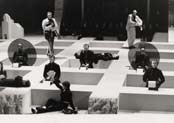
Patmos
(1989)Libretto adapted from the Book of Revelation by D E Sattler (G)
Major roles: S,A,T,Bar,B; minor roles: 3S,3A,CT,T,Bar,B;
boys' chorus; dancers
1.afl.1.corA.Ebcl.bhn.1.dbn-2.2.atrbn.ttrbn.0-timp.perc(2):glsp/xyl/
tubular bells/tgl/sleigh bells/cowbells/large cowbell/susp.cym/cyms/
tam-t/2 pairs of bongos (large and small)/tamb/SD/TD/BD/2wdbl/
2tpl.bl/2maracas (different sizes)/guiro-harp-strings(5.0.4.3.1)
Abkürzungsverzeichnis (PDF)
Boosey & Hawkes
Munich Biennale
Ruth Berghaus, Regisseur
Dirigent: Adam Fischer
Ensemble: Staatstheater Kassel
| JOHANNES I | Tenor |
| JOHANNES II | Bariton |
| X | Baß |
| ANGELUS NOVUS | Sopran |
| ANGELUS ANTIQUUS | Alt |
| Terzett I | 3 Soprane |
| Terzett II | 3 Altstimmen |
| QUARTETT (Die vier Tiere) | Countertenor/Tenor/Bariton/Bass |
| Kinderchor (die 24 ältesten) | 12 Soprane, 12 Altstimmen |
| 2 Kinderstimmen aus dem Chor | Sopran/Alt |
| Sprechchor | Orchestermusiker |
| Engel mit Weihrauch/Die Ehefrau/Die Braut des Lammes/Die Hure Babylon | Tänzerin |
| Das Lamm/MICHAEL/Engel mit Sense | Tänzer |
| Der Drache/Engel mit himmlischer Heerschar | Tänzer |
| Erstes Tier | Tänzer |
| Zweites Tier | Tänzer |
| Die vier Reiter der Apokalypse | 1-4 Tänzer |
| Die vier Engel des Windes | 1-4 Tänzer |
| Die Engel der sieben Plagen | 1-4 Tänzer |
Nach dem alten Jüdischen Kalender ist mit dem Jahr 5750 die Abendstunde des sechsten Jahrtausends unserer Geschichte angebrochen, und der fortgeschrittene Zustand der Zivilisation auf diesem Erdball läßt die kommenden Plagen ahnen, nötigt uns schon, wohl ans Ende zu denken, an Ruin und Krisis. Mit Zittern und Zagen stehn wir da, blicken auch hilflos zurück auf all das, was wir leichtsinnig durch die vielen Jahrhunderte und Generationen an Chancen verspielt, an Unterweisung mißachtet, an prophetischem Geist verraten haben.
Dazu gehört auch ein wunderbarer, im Neuen Testament überlieferter Text, der uns betrifft: die Apokalypse des Johannes, diese emphatische, aus der großen Tradition der altjüdischen Prophetie und zugleich unmittelbar aus der christlichen Zeitenwende hervorgegangene Kulturkritik, Bußpredigt und Gesamtschau unserer endlichen Geschichte mit dem darübergewölbten metaphysischen Horizont.
Wolfgang von Schweinitz
poetisch