







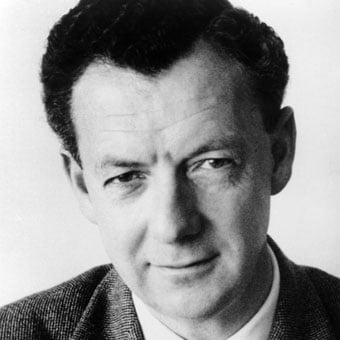
Benjamin Britten

Benjamin Britten was born in Lowestoft, Suffolk, on the east coast of England, on 22 November 1913. Although he was already composing vigorously as a child, he nonetheless felt the importance of some solid guidance and in 1928 turned to the composer Frank Bridge; two years later he went to the Royal College of Music in London, studying with Arthur Benjamin, Harold Samuel and John Ireland. While still a student, he wrote his ‘official’ Op. 1, the Sinfonietta for chamber ensemble, and the Phantasy Quartet for oboe and string trio, and in 1936 he composed Our Hunting Fathers, an ambitious song-cycle for soprano and orchestra, which confirmed Britten’s virtuosic vocal and instrumental technique. He was already earning his living as a composer, having joined the GPO (Post Office) Film Unit the previous year; the collaboration he began there with the poet W. H. Auden was to prove an important one throughout his career.
Britten found himself in the United States at the outset of World War Two and stayed there for three more years, returning to Britain in 1942. In America he produced a number of important works, among them the orchestral Sinfonia da Requiem, the song-cycle Les Illuminations for high voice and strings, and his Violin Concerto. With the opera Paul Bunyan he also made his first essay in a genre that would be particular important to him.
Back in Britain, where as a conscientious objector he was excused military service, he began work on the piece that would establish him beyond question as the pre-eminent British composer of his generation – the opera Peter Grimes, premiered to an ecstatic reaction on 7 June 1945. The Young Person’s Guide to the Orchestra: Variations and Fugue on a Theme of Purcell – a cornerstone of the orchestral repertoire – was first performed in the following year. Indeed, Britten now composed one major work after another, among them the operas The Rape of Lucretia (1946), Albert Herring (1947), Billy Budd (1951), Gloriana (1953), The Turn of the Screw (1954), Noye’s Fludde (1957), A Midsummer Night’s Dream (1960), Owen Wingrave (1970–71) and Death in Venice (1971–73); the Nocturne for tenor and orchestra (1958), the War Requiem (1961–62), a Cello Symphony (1963) for Rostropovich and his orchestral Suite on English Folk Tunes (1974).
Britten’s importance in post-War British cultural life was enhanced by his founding of the English Opera Group in 1946 and the Aldeburgh Festival two years later. His career as a composer was matched by his outstanding ability as a performer: he was both a refined pianist and a spontaneous and fluent conductor – his Mozart was particularly highly esteemed. Britten’s later career was clouded by bouts of ill-health, culminating in heart disease. He never fully recovered from open-heart surgery in 1973, and died on 4 December 1976, at the age of 63, a few months after being appointed a life peer – the first composer ever to know that honour.
Benjamin Britten is published by Boosey & Hawkes.
This biography can be reproduced free of charge in concert programmes with the following credit: Reprinted by kind permission of Boosey & Hawkes
Bestselling Titles by Benjamin Britten
-
 Publisher: Boosey & HawkesIn Stock: Usually despatched within 24-48 hours$16.50
 -
 Publisher: Boosey & HawkesIn Stock: Usually despatched within 24-48 hours$16.50
 -
 Publisher: Boosey & HawkesUsually despatched within 7-10 working days - Lead times may vary in the case of supplier shortages or delays$19.04
 -
 Publisher: Boosey & HawkesIn Stock: Usually despatched within 24-48 hours$6.34
 -
 Publisher: Boosey & HawkesIn Stock: Usually despatched within 24-48 hours$31.74
 -
 Publisher: Boosey & HawkesIn Stock: Usually despatched within 24-48 hours$19.04
