







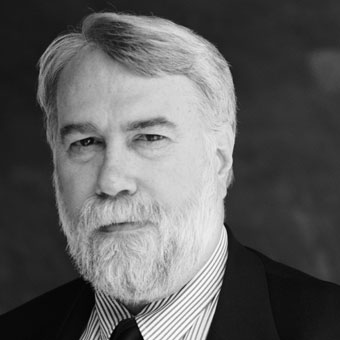

An introduction to the music of Christopher Rouse
by Frank J. Oteri
Although he has composed an impressive range of works for a variety of ensembles—from his early series of energetic percussion pieces to three highly individualistic string quartets as well as a formidable work for wind ensemble—Christopher Rouse is most fully in his own element when he is creating music for an entire symphony orchestra. Taking maximum advantage of the vast range of timbre combinations as well as the dynamic extremes which an orchestra is capable of producing, Rouse’s orchestra music is a visceral, immersive experience.
Though Rouse’s highly personal sound world is instantly recognizable as his own no matter what he has written, his vocabulary utilizes materials that span the entire range of Western music history—from Gregorian chant and Renaissance madrigals through to the Romantic period and beyond to a broad gamut of more contemporary sounds spanning ideas from the modernists to the minimalists. Yet Rouse’s music is defiantly not beholden to modernism, minimalism, or any other intellectual –ism; it always has as its source an intuitive, emotional core. Even gestures from rock music, a nod to the era he grew up in, more than occasionally surface in his music. Sometimes Rouse incorporates direct quotations from earlier music, e.g. leitmotifs from Wagner’s Der Ring des Nibelungen form the basis of Der gerettete Alberich (1997), his de-facto concerto for percussion and orchestra. But unlike postmodern pastiche which plunders the artifacts of history in an attempt to eradicate historical narratives, Rouse’s music celebrates and affirms these narratives. It is always clear that he deeply loves and reveres the canon of classical music and everything that he slowly and meticulously writes (still by hand!) carries classical music’s weight, dare I posit monumentality—as if your life and ultimately the fate of mankind depended on every note.
Despite their relative brevity comparable to his larger scale works, pieces like The Nevill Feast (a giddy Medievalist romp from 2003 originally written for the Boston Pops), the dramatic 2013 Prospero’s Rooms (which Rouse has described as “an overture to an unwritten opera”), the exceedingly lush Rapture (2000), the tumultuous Odna Zhizn (2009), or his sole piece for chamber orchestra—the portentous Iscariot (which is dedicated to John Adams, who conducted its premiere performance)—are all invested with multiple layers of meanings. Unlike traditional concert openers which are designed to ease listeners into the rest of the program, Rouse’s shorter orchestral pieces make listeners perk up their ears, arguably enabling greater preparedness for every other piece of music to come. Though not for orchestra per se, Rouse’s 2006 Wolf Rounds (for wind ensemble), with its manic chain of riffs that gradually transform into one another, would also be a fabulous way to begin a concert. (The strings could later be given equal time by performing his hefty 1990 Concerto Per Corde, a symphonic expansion of his introspective String Quartet No. 2.) The spine-tingling 1985 Phantasmata, which incorporates his earliest mature orchestral piece, The Infernal Machine from 1981, is something of a mini-symphony in that a very wide variety of ideas are packed into its three brief, dream-like movements.
Rouse’s actual First Symphony came the following year, in 1986, though it seems to begin where the two most imposing symphonists of the early 20th century left off. A lengthy Adagio lasting nearly 30 minutes, it calls to mind another very expansive Adagio—the one that Gustav Mahler fashioned for the Tenth Symphony that he did not live to finish. Yet one of the only antecedents for a totally complete symphonic statement, with all its requisite variety in such an atypically economic fashion, is the single-movement Seventh Symphony of Jean Sibelius, for whom subsequent composition became something of an albatross. Not so for Rouse, who was already pondering his own Second Symphony before completing his First, although he did not entirely flesh out the latter work until 1994. While the Second initially seems to feature a somewhat more conventional design than its predecessor (three movements: fast, slow, fast), a closer listen reveals its structural idiosyncrasies. For starters, the three movements are played together without pause and the opening and closing Allegros are constructed from the same musical materials, a concept somewhat akin to the mirror forms in the mid-period compositions of Béla Bartók. The middle movement, on the other hand, is inspired by a more personal connection to another composer—Stephen Albert, a close friend of Rouse whose sudden death as a result of an automobile accident in 1992 was the trigger for Rouse’s mournful and often angry Adagio. Rouse waited 17 years before unveiling his Third Symphony, which is also cast in an unusual format—two movements: a mercurial Allegro followed by a set of Variations in varying tempos. Again, a composer of great importance to Rouse served as the work’s role model: Serge Prokofiev—whose music has fascinated Rouse since his childhood—cast his underappreciated Second Symphony in this manner inspired by the format of Beethoven’s final piano sonata. Thankfully, we won’t have to wait so long for Rouse’s next symphony; he’s been furiously at work on his Symphony No. 4 which the New York Philharmonic will premiere next season during his ongoing tenure as their Marie-Josée Kravis Composer-in-Residence.
For centuries, the concerto has served as an apt sonic metaphor for the struggles between being an individual and a member of a society. Christopher Rouse’s dozen concertos, which are probably his most widely performed and honored compositions, frequently turn that struggle into all-out warfare in which the virtuosity of the soloist—often performing on a less common solo instrument—rages in battle against a highly virtuosic orchestra. His first, the tragic Trombone Concerto (1991) that earned him the Pulitzer Prize, is a tour-de-force for the bass-ranged brass instrument which soars below the turbulent orchestration. Among Rouse’s most moving compositions is his Celtic-infused Flute Concerto (1994), in which the soloist and the rest of the orchestra are each given sumptuous, extremely memorable melodies. Rouse’s 1999 Concert de Gaudí for guitar and orchestra, which fetched the Grammy Award for Best Contemporary Classical Composition, evokes the same Iberian sound world as the world’s most famous guitar concerto, Rodrigo’s Concierto de Aranjuez, but utilizes an even wider harmonic and timbral palette. His 2004 Oboe Concerto is an extraordinary contribution to the repertoire of this underutilized solo instrument; his latest, Heimdall’s Trumpet (2012), makes a compelling case for the trumpet as an effective counterweight to the orchestra. His concertos for more standard solo instruments are also exceptional, particularly his haunting Violin Concerto (1991), which is one of the finest contemporary American contributions to this most enduring of concerto formats.
Rouse has composed few vocal works, but they are among his most aesthetically satisfying achievements. His 1998 orchestral song cycle, Kabir Padavali ("Kabir Songbook"), is something of a concerto for soprano and orchestra as well as a compelling monodrama that generously explores the sonic possibilities inherent in the words of the 15th-century Indian mystic Kabir’s poetry, among the pinnacles of world literature. Karolju (1990), a series of Christmas carols for chorus and orchestra that is not far away from the edge-of-your-seat sound world of Carl Orff’s popular Carmina Burana, is a jubilant addition to the holiday repertoire. While Rouse was in the midst of composing his massive evening-length Requiem, his heftiest musical work thus far, the terrorist attacks of September 11, 2001 occurred. As a result, there is a small symbolic reference to that tragedy in his score. But Rouse did not want to compose a 9/11 memorial, believing that—to quote his own words—“some tragedies [are] too enormous to consecrate with anything more than deep but silent grieving.” So rather, the work follows in the footsteps of such universal humanistic works as Johannes Brahms’s A German Requiem and Benjamin Britten’s War Requiem, completed a half century earlier. Another composer whose spirit looms large in Rouse’s Requiem is Hector Berlioz, another of his compositional heroes. In fact, the work was commissioned to honor the bicentenary of Berlioz’s birth and Rouse pays homage to Berlioz by setting the same version of the Latin liturgical text that Berlioz did, observing the exact same cuts, alterations, and re-orderings, albeit accompanied by music that is all his own. Also, like Brahms and Britten, Rouse includes texts in his own language, interpolating poetry by John Milton, Ben Jonson, and Nobel Laureate Seamus Heaney.
Christopher Rouse’s devotion to the entire history of Western music—an encyclopedic embrace spanning Georg Friedrich Händel, Joachim Raff, and William Schuman, as well as Led Zeppelin and Moby Grape—has given him a vast canvas on which to apply his sonic brushstrokes. Rouse’s commitment to listening, and subsequently absorbing and internalizing everything he has heard, continues to make his music such a rewarding experience for so many listeners.
© 2013 by Frank J. Oteri
Bestselling Titles by Christopher Rouse
-
 Publisher: Boosey & HawkesSpecial Order: Usually despatched within 20-30 working days - Lead times may vary in the case of supplier shortages or delays$41.28
 -
 Publisher: Boosey & HawkesSpecial Order: Usually despatched within 20-30 working days - Lead times may vary in the case of supplier shortages or delays$37.47
 -
 Publisher: Boosey & HawkesUsually despatched within 7-10 working days - Lead times may vary in the case of supplier shortages or delays$74.30
 -
 Publisher: Boosey & HawkesUsually despatched within 7-10 working days - Lead times may vary in the case of supplier shortages or delays$71.11
 -
 Publisher: Boosey & HawkesUsually despatched within 7-10 working days - Lead times may vary in the case of supplier shortages or delays$35.55
 -
 Publisher: Boosey & HawkesUsually despatched within 7-10 working days - Lead times may vary in the case of supplier shortages or delays$45.71
