





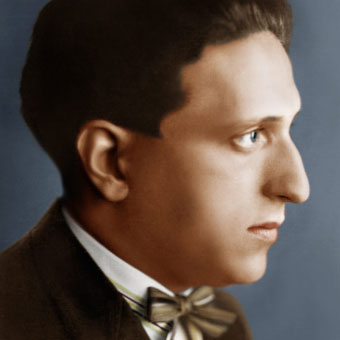
Pavel Haas
The Moravian-born composer Pavel Haas was interned at the Terezín camp before his death at Auschwitz * Studied in Brno at the Music School of the Philharmonic Society and after the First World War at the State Conservatory, where he became the foremost pupil of Janacek * His studies with Janacek and enthusiasm for newly formed Czech Republic turned him from mainstream German Romanticism towards local folk traditions * Early successes included the Fata Morgana song cycle setting texts by Tagore, String Quartets Nos.1 and 2 and Wind Quintet * Mature style reached in 1930s with tragicomical opera Sarlatan and String Quartet No.3 * Musical language embraces Bohemian influences, Jewish folksong, Hebrew chant, jazz and polymetric writing * Compositional output interrupted by frequent commissions to write music for theatre and film productions * Works from final years at liberty include an unfinished Symphony, completed posthumously * Deported by Nazis to Terezín in 1941 in ill health, but encouraged by Gideon Klein to resume composition * Works written in Terezín include Study for String Orchestra premiered in the camp under Karel Ancerl, and Four Songs on Chinese Poetry
Works by Pavel Haas include:
String Quartet No.1 (1920), No.2 (1922) and No.3 (1938)
Sarlatan (1934-37) Tragicomical opera in three acts
Symphony (unfinished) (1940-41) orchestration completed by Zdenek Zouhar
Four Songs on Chinese Poetry (1944) for baritone and piano
"Our will to create art has always been as strong as our will to survive". — Pavel Haas, Terezín