






Detlev Glanert orchestrates Fanny Hensel’s The Year
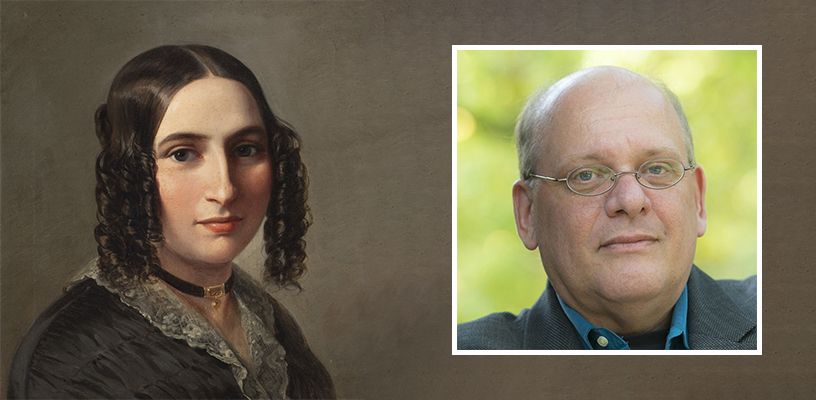
Acclaimed for his orchestrations of 19th century classics by Schubert and Brahms, Detlev Glanert has turned to the piano cycle Das Jahr by Fanny Hensel (1805-47), too often overshadowed as a composer by her brother Felix Mendelssohn.
Detlev Glanert’s new orchestration of Fanny Hensel’s expansive piano work Das Jahr, only rediscovered in 1989, casts new light on a composer of wit and imagination a century and a half after her death. Commissioned by the Salzburg Mozarteum Orchestra, the Dresden Philharmonic and the Scottish Chamber Orchestra, the orchestrated cycle is premiered in Salzburg on 15 October under the baton of Roberto González-Monjas. Scored for medium-sized orchestra, the work can be performed complete, or the year can be divided into months or seasons.
In this interview Detlev Glanert introduces the work and his new orchestration:
How did you discover Fanny Hensel’s Das Jahr?
Naturally, I was aware of the existence of her compositions, especially as her main publisher, Bote & Bock, was also mine. But it was only the initial enquiry from the Salzburg Mozarteum that prompted me to take a closer look at her music. At first I had preconceptions, as I had expected the sort of salon pieces that were produced in such vast numbers in the 19th century – but that changed abruptly when I read the score and became better acquainted with her other works. Das Jahr stands out from her entire oeuvre due to its sheer scale; there is no other piece of this magnitude. Above all, I took on the project because, as soon as I read the score, I could immediately hear an orchestra.
How does Hensel depict the changing of the seasons?
She finds a distinct form and expression for each month; the programmatic musical depictions possess the freshness of something new, of a different perspective. And her cyclical, continuous themes are fascinating; in my view, she was very keen to experiment here, and also in her use of harmony – sometimes more so than her brother. In Das Jahr we also encounter so-called autobiographical influences often as ‘external’ events, such as carnival, the summer heat, hunting, and snowstorms. Her extensive quotations from Protestant chorale music are also very interesting, on the one hand as a reference to Bach, and on the other as a reference to the seasons.
How is the progression of the work organised?
I have decided to follow her line of thought consistently and always group three months together. In two instances, this was her choice; in the others, it was mine. Furthermore, there are certain melodic motifs – seeds that recur in almost every month, and in some cases several of them – which I have provisionally termed ‘idée fixe’. All of these are strong indications of a grand thematic arc.
How did you approach the orchestration? Did your own musical world intervene?
I wanted – and had to – take a back seat here as a composer myself. It would have struck me as inappropriate to enter into a ‘dialogue’ with a composer who had been silent for so long. Rather, one needs to engage with her music undisturbed before constructing a counterpart. I would be delighted if the listener’s impression was that Fanny Hensel had orchestrated Das Jahr herself.
How did you transform piano figurations into orchestral music?
Firstly, I treated the original version as I would a good piano reduction of its era and compared the printed edition scrupulously with the manuscript, taking into account a number of variant sources. The figurations, which were at times distinctly pianistic, could be transposed to the orchestra according to the Berlioz principle; additional octaves were inserted where appropriate, and changes were made where it was evident that two hands were no longer sufficient.
Did you aim for a particular historic orchestral sound?
The forms of expression (and also the clichés!) typical of the period are well known, so I was able to orchestrate around them, taking the orchestral sound of 1841 as my starting point: 2 flutes, 2 oboes, 2 clarinets, 2 bassoons, 2 horns, 2 trumpets, 1 trombone, timpani, harp, strings. The additional trombone and harp formed the core of Italian theatre orchestras around 1840 (as heard, for example, in Rossini), so I imagined that Fanny Hensel would have liked these added colours.
Having worked on the orchestration, what is your view now on Hensel and her music?
My conclusion is that she was an outstanding composer (who must also have been a fascinating conductor) who provided an enrichment of the musical language of the first half of the 19th century. It is a tragedy that she was never able to develop her full potential, due to a lack of opportunities, but above all because of her far too early death. The wider concert-going public should get to know this music despite its heavenly length, and for that I wanted my orchestration to offer a musical invitation into a still unknown world. I hope it will lead to an appreciation of an intelligent and imaginative, witty and deeply sensitive musician, whose tremendous vitality comes across to us in her music.
Fanny Hensel, arr. Detlev Glanert
Das Jahr (1841, arr. 2025) 43'
12 character pieces for piano, arranged for medium-sized orchestra
2(II=picc).2.2.2-2.2.1.0-timp-harp-strings
15 October Mozarteum Orchestra Salzburg (world premiere)
21/22 October Musikkollegium Winterthur (Swiss premiere)
31 October/1 November Dresden Philharmonic (German premiere)
7 November/15 December/13 April Hagen Philharmonic (selections)
25/26 April Scottish Chamber Orchestra, Edinburgh/Glasgow (UK premiere – selections)
This month brings the first performance of Detlev Glanert’s Concerto for Two Violins and Orchestra, created for soloists Midori and Renaud Capuçon. Following the Leipzig Gewandhaus’s premiere on 24 September with Semyon Bychkov on the podium, performances are scheduled with the Bruckner Orchestra in Linz and Vienna under Jonathan Nott on 5 and 6 March and with the New World Symphony in Miami in 2027.
> Further information on Work: Das Jahr
Fanny Hansel portrait by Moritz Daniel Oppehheim (Wikimedia Commons) / Detlev Glanert photo by Bettina Stöss