






Interview: Courtney Bryan on Suddenly Last Summer
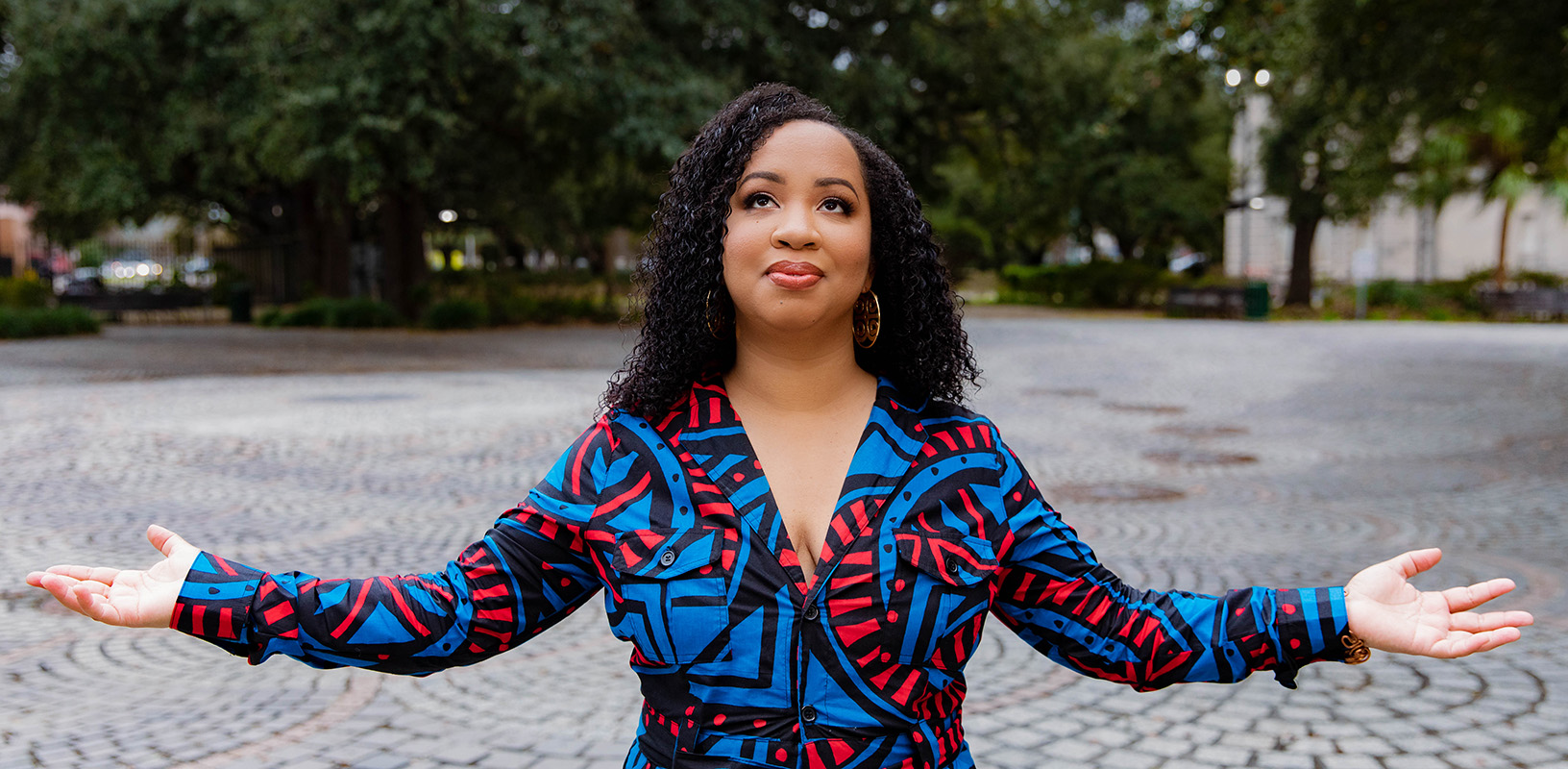
Courtney Bryan discusses Suddenly Last Summer, an opera-theater project based on Tennessee William’s iconic play, premiering in June at Bard.
From June 25 to July 19, the Fisher Center LAB at Bard presents the world premiere of Suddenly Last Summer, with music by composer Courtney Bryan and libretto by Gideon Lester and director Daniel Fish. The new work is based on Tennessee Williams’s Southern Gothic drama, which follows a young woman’s account of a traumatic past, as her powerful relatives attempt to control the narrative—and her fate.
In this interview, Bryan reflects on the opera’s exploration of truth and power, as well as the collaborative process behind creating a hybrid opera-play format that integrates music and spoken theater.
Can you describe the conceptual ideas behind the piece, and how they shaped the decision to create a hybrid opera-play format, where singers and actors share the stage?
CB: The drama centers on uncovering the truth of what happened to Sebastian—a character we never actually meet since he dies before the play begins. The only person who knows what really happened to Sebastian is his cousin Catharine, who the rest of the characters are trying to silence.
We began exploring a conceptual idea that director Daniel Fish suggested: Catharine, as the “voice of truth,” would be the only character who sings, while the other characters are speaking roles. In this way, the piece was developed through a collaborative process with the creative team, drawing on a music-theater model of development.
In addition to Catharine singing, the work includes a boys choir. We chose to specifically include the voices of preteen boys, which are integral to the story, at times representing the group of boys Sebastian exploited, and who ultimately bring about his demise.
What’s the dramatic impact of combining speech and singing in performance?
CB: I wrote the score knowing I needed to balance the music and acting happening onstage simultaneously, without one form taking precedence over the other. It’s like you're watching two scenes at the same time.
For example, Catharine — who is being held in a mental institution — is onstage while her aunt describes her as babbling and incoherent. As the other actors speak, Catharine sings these long notes that don’t form complete, intelligible phrases. The audience sees and hears her, but her presence feels abstract because you don’t understand what she’s saying. The speech and singing exist in different universes, and that juxtaposition makes Catharine feel both present and removed.
Timing was also a very important consideration — like, how to balance the pace of spoken text with sung text. Speech moves more quickly, while singing, even at a fast tempo, is musical and spread out. I had to create a score with flexibility built in for the different types of performance being layered.
How did you approach writing music for Catharine, the “voice of truth”?
CB: Over the course of the opera, Catharine goes from singing really stretched out, unintelligible phrases to, ultimately, speaking her truth. After being given a truth serum, she begins to deliver text more quickly and clearly, almost as if speaking (though she’s singing throughout). It’s a gradual progression that builds to a climax in Scene 4.
As she begins singing her truth, the music becomes very dramatic. I loved the idea of exploring the full range of her voice. There are moments when she’s sharing some very disturbing details, and the music moves into her low register, giving her a grounded, controlled quality. At these big moments in the opera, I wanted Catharine to move between different modes of expression — something between babbling and shouting out her truth.
What’s the significance of birdsong in this opera?
CB: Birds are referenced throughout Tennessee Williams’s play. In his notes, he includes specific descriptions of which birds are heard and the kinds of sounds they make. While they aren’t main characters, they form a presence in the world of the play. At the end, the boys are described as transforming into black birds that devour Sebastian.
I knew early on that I wanted to incorporate birdsong into the musical language of the opera. Williams mentions sweet-singing birds and flesh-eating ones, which led me to research different types, like the yellow warbler, red cardinal, and vultures, as well as birds native to uptown New Orleans, where the story is set. I created a chart of bird song transcriptions for the ensemble players, with instructions for how to follow the general shape of the bird call while also improvising, so the effect feels natural. Some passages feature notated bird calls, while others suggest the sound of wind or flapping wings.
In Scene 2, there’s a Choral Feature written for the boys choir that explores two types of writing. Some of the choral writing features harmonies inspired by Billy Strayhorn and Duke Ellington, sung on open vowels. And then there’s writing for the choir that goes into improvised birdsong.
As a New Orleans native, what drew you to this play and what did you want to capture through this drama?
CB: It was a great challenge to take on a play set in New Orleans. When I first read the script, I could hear the accents and the pacing of the voices immediately. But it represents a very different place than my New Orleans. The play is about a very rich white family in the 1950s Garden District—what someone from New Orleans would recognize as “old money.” So it was interesting to engage with a different side of New Orleans than I know.
What drew me most to the project was the emotional intensity of Tennessee Williams’s writing. As a composer who thinks about capturing a lot of different types of emotions in music, I knew his text could push me in new musical directions.
For example, in the closing aria, Catharine describes Sebastian’s final moments, as he runs and the boys transform into birds and devour him. Setting that scene to music was a particular challenge. I’m used to dealing with difficult topics in my music, but oftentimes I bring an element of hope. Here, the only sense of hope we found was in Catharine finally speaking her truth — but there’s so much gruesomeness in that last image.
Ultimately, it was the intensity of Tennessee Williams’s storytelling — how his stories haunt you and stick with you — that drew me to this project the most.
> Further information on Work: Suddenly Last Summer
Photo: Taylor Hunter