






Interview: Elena Firsova on Completing Sofia Gubaidulina’s Final Work, Prolog
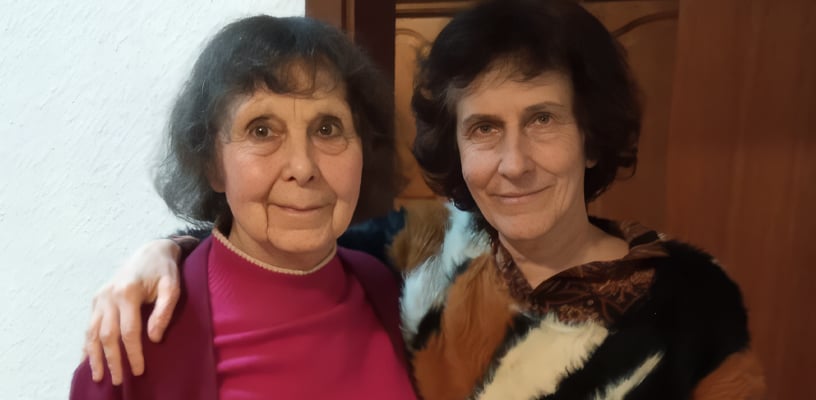
Composer Elena Firsova reflects on her 50-year friendship with Sofia Gubaidulina and the extraordinary task of completing Prolog, Gubaidulina’s final orchestral work, ahead of its world premiere with the Boston Symphony Orchestra and Andris Nelsons.
You and Sofia Gubaidulina were close friends for many years. Can you describe your relationship?
EF: We were very close friends for exactly 50 years. We became close in 1975, just after I graduated from the Moscow Conservatory. Sonia—as I always called her—had heard about my cello concerto, written for my diploma, through a mutual friend, and later that year she came to our house to listen to it. From that moment, we immediately became very close.
Of course, she was from the previous generation, like Denisov and Schnittke, but with her we almost immediately felt as though we were from the same generation. She asked my husband, Dmitri Smirnov, and me to call her simply Sonia.
From then on, we shared our recordings with each other, went to each other’s performances, and met constantly—at our house, at hers, at Denisov’s house, and at concerts. Sonia often said that she felt like a sister to Dmitri and me. We were really very close.
So, after 50 years of friendship, my work on Prolog feels in some way like a crown to that friendship.
How did you react when you were asked to complete Prolog?
EF: My first emotional reaction was that I had to refuse.
Sonia and I had discussed this question many times, and we agreed that it is generally not good when a composition is finished by another composer. We talked about Mozart’s Requiem as perhaps the rare example where it worked, although even there you can hear where it is no longer entirely Mozart.
So when I was asked to finish Sonia’s composition, my first thought was: I should not do it.
But when I came home and told my daughter, she said, “Mama, you have to do it. If you refuse, almost certainly somebody else will be asked, and nobody will be able to do it as well as you, because you knew Sonia so well and you know her music perhaps better than any other composer. For the memory of Sonia, you have to do it.”
I thought about it for a while and decided that perhaps my daughter was right. So I agreed.
What material had Gubaidulina actually completed, and what did you have to work from?
EF: I had expected there to be much more. In our last telephone conversation, in October 2021, Sonia told me that Prolog was almost finished. She said that she only needed to make the clean manuscript, but because she was already weak, she was working very slowly.
When I was later asked to complete the work, I was told that she had left many sketches. Because Sonia had told me the piece was almost finished, I assumed I would mainly have to sort through them and establish their correct order.
But when I received the materials, I discovered something very different. There was one clearly completed manuscript of approximately six and a half minutes. There were many other sketches, but most related to material already contained in that fragment. Others consisted of things like chromatic scales, chords, or mathematical figures whose intended meaning I could not determine.
So in practice, I worked principally from that six-and-a-half-minute completed fragment and from a written plan that Sonia had left for the whole composition. The completed piece is around 20 minutes, so a substantial amount of music still had to be composed.
What did Gubaidulina’s plan tell you about the structure of the piece?
EF: The plan was mainly in words, and it was quite detailed about the dramatic and philosophical progression of the piece. There were roughly 10 different sections. I followed this structure as closely as I could, although there were a few instructions whose meaning I simply could not reconstruct.
Questions are fundamental to the work. In the music Sonia completed, there is a first question, a second question, a third question. Her plan then describes what should happen: the chorus trying to understand what is happening; the Abyss; the tragedy of the individual; attempts to escape the Abyss and move toward the light; the appearance of God; the suffering of humanity; a final attempt to move the stone of Sisyphus; the last question; and finally, chaos.
Sometimes the plan gave an image or idea without any music at all. For example, in the Abyss she specified an oboe solo representing individuality and the tragedy of individuality, but she left no notes for it. I therefore had to compose the solo myself.
I tried to do this according to her musical principles. I normally work with melodies and the development of melodies. Sonia always said that she did not work with melodies—she worked with intervals. So for this oboe solo, I tried to think in her way: It still needed emotion, but it is not a typical melody. It is built more from the different intervals between sounds.
One striking feature is the appearance of a cross within the musical score. Can you explain how this works?
EF: Sonia’s plan indicated that there should be a cross in the musical score. This is something she had done before, and it was a technique I knew very well. Denisov also used this kind of idea, and my husband and I had done similar things in our own scores.
You can create the image through opposing musical lines. For example, the woodwinds descend while the strings ascend. At one point those lines intersect, so visually they create a cross in the score.
I actually created two crosses. Sonia had asked for one, but I introduced another just before everything falls into the Abyss. The strings sustain a chord spread across the register while the horns and trumpets move through it, crossing the sustained sonority. So again, the musical movement creates the image of a cross.
Did you draw on other of Gubaidulina’s works while completing the score?
EF: Offertorium is one of my favorite works by Sonia, and I listened to it again and studied some of its textures.
At the end of the completed fragment of Prolog, Sonia had begun a new section whose treatment of the strings reminded me very strongly of the final section of Offertorium. The harmony and meaning were very different, but the orchestration and the way the string texture develops were very similar. Looking at Offertorium helped me understand what she might have intended—to expand the harmony through the entire register. Later, for the great chaos near the end of Prolog, I again took the idea of a musical texture from Offertorium.
At the very end, I return to an idea from Sonia’s original fragment: a very quiet tritone in the flute, pianissimo, with a quiet tam-tam. That is how the piece ends.
Do you feel that your compositional styles and philosophies are aligned?
EF: We are not opposite composers, but we are certainly different.
One important difference is that Sonia was deeply religious, and her music is very often connected with religious and Biblical ideas. I grew up in a family of scientists and in a very different intellectual atmosphere. I am not an atheist, but my understanding of these questions is different.
For me, spirituality does not necessarily have to be connected with a particular religion. When I write music, I also think about a higher mind, the universe, and these kinds of questions. So perhaps we were looking at some of the same fundamental questions from different perspectives.
There is also a difference in how we compose. As I said, I tend to think in melodies and their development, whereas Sonia thought much more in intervals. And my approach to musical form is generally more laconic. I rarely write very long compositions. Sonia’s musical language usually needs more space and time to unfold.
In completing Prolog, I tried to put these differences aside and follow her musical thinking as closely as I could.
Given how much music you ultimately had to compose, how do you define your role in the project?
EF: My feeling about this changed over time.
When I was deeply involved in the work and had just finished it, I was very happy with what I had done, and I was so involved that, for a moment, I had the feeling that it was actually my composition.
But after some time, I realized something different. I had tried to make my interference—my “invasion”—as small as possible. I used the musical material in Sonia’s fragment, her ideas and her style. I tried not to introduce my own style at all.
And yet now, several months after finishing it, I have the strange feeling that the composition is not mine, because it is not my style and the musical material is not mine. At the same time, it is not entirely Sofia’s, because if she had lived to finish it herself, she certainly would have written a different composition. Even the form would probably have been different.
So it is not mine, and it is not hers. It is something else—a participation of both of us.
Is there any moment in Prolog where you feel it is unmistakably Gubaidulina’s voice?
EF: I think her voice can be heard everywhere, because it is her style and her ideas.
At the same time, I am sure that the form would have been different if she had completed the piece herself. Despite having her plan, I could only make my own decisions about how to realize it. Her approach to musical form was more expansive than mine, and she certainly would have written some things differently.
I cannot say exactly what those differences would have been. But her voice is everywhere—in the material, in the ideas, and in the questions that drive the entire work.
Inteviewed by Carol Ann Cheung, 2026