






Mark Simpson: new Piano Concerto premiere by Tamara Stefanovich
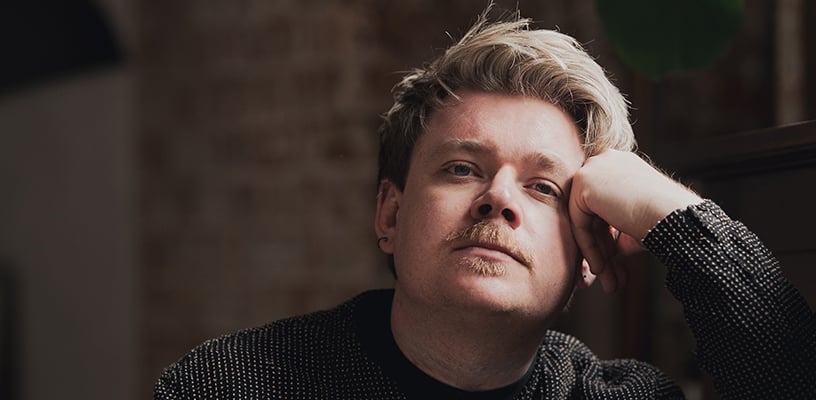
Tamara Stefanovich is soloist in the first performances of Mark Simpson’s new Piano Concerto, with the London Philharmonic Orchestra at the Royal Festival Hall and Saffron Hall on 23/24 October, and with the Bergen Philharmonic Orchestra on 19 November, all conducted by Edward Gardner.
Mark Simpson’s new Piano Concerto is unveiled by soloist Tamara Stefanovich at the Royal Festival Hall in London on 23 October, the latest in a series of concertos by the British composer including acclaimed works for violinist Nicola Benedetti, violist Timothy Ridout and electric guitarist Sean Shibe. The premiere of the new Piano Concerto features the London Philharmonic Orchestra conducted by Edward Gardner with a further performance at Saffron Hall on 24 October. Stefanovich and Gardner also take to the concert platform for the work’s Norwegian premiere on 19 November with the Bergen Philharmonic Orchestra at the Grieghallen in Bergen. The concerto's US premiere follows on 8 January with soloist Jeremy Denk and the Cincinnati Symphony Orchestra conducted by Cristian Macelaru.
> Visit the London Philharmonic Orchestra website
> Visit the Bergen Philharmonic Orchestra website
> Visit the Cincinnati Symphony Orchestra website
Tamara Stefanovich is one of the leading interpreters of 20th- and 21st-century piano music and has worked with some of the greatest composers of our time. Cast in three movements, with a 23-minute duration, Simpson’s Piano Concerto moves from a restless, impassioned intrada through a high energy central movement, to an explosive and heroic finale. The work was commissioned by the London Philharmonic Orchestra, Bergen Philharmonic, Philharmonie Essen and Cincinnati Symphony Orchestra.
In this interview Mark Simpson introduces his new Piano Concerto and its composition:
What’s your relationship with the piano as an instrument?
I don't think that I'm different to any composer that has ever lived in saying that the piano plays an integral part to my composing practice. Like all other instruments, it is a means to bring into existence the sonic reality of an internalised sound or essence.
When playing music from different periods on the piano it’s not just a case of simply hearing the music and recognising the style but having a distinct feeling of it in my mind, body and soul. Because of the ubiquity of the keyboard as a compositional tool for composers across musical history, the vastness of the repertoire available to us means we can build a unique mind/body catalogue that stretches over centuries. You embody the music. Meaning that when it comes to trying to find new ways of creating music that feels true to you, you're able to navigate through that catalogue and find a way of expressing yourself that feels (hopefully) unique. In my own piano concerto, and as with all my other music, the decisions that I make are always drawn on via this knowledge.
My own personal history with the instrument was this: I first learnt the electronic keyboard, and then briefly the cello. With the ability of being able to read bass clef fluently after my cello lessons I then taught myself the piano. Bits of Beethoven, Mozart, Bach and Chopin and Bartok. After a while I had some lessons but, when my clarinet career took off at a young age, I was unable to keep up the level of practice needed to be comfortable performing in public. However, my technique was good enough for me to develop a way of playing that has informed my writing ever since. Regardless, I have always written music at the keyboard. In fact, I wrote the piano part to my piano concerto myself at the piano. So, on some level it is a marker for the level of ability I have.
How does the new work engage with the rich hinterland of keyboard composition and piano concertos?
I wanted my piano concerto to sit within a recognised history of the piano concerto repertoire. The spirit of Liszt, Ravel and Rachmaninov are all in the mix. But never in direct quotation. What I realised when I finished the piece was that it had an ‘heroic’ quality to it - particularly in the last movement. In the first short movement the piano writing is quite florid, there are tendrils that link back to the virtuosic pianism found in the 19th-century. I wanted it to burst forth in a flurry of virtuosity. In the second movement I was searching for an electric, lightning-like quality. In particular, the quick succession of notes passed between two hands as a manic/obsessive gesture. The third movement is grander and more 'symphonic' in nature. At the time or writing, all of these ideas were unconscious decisions, though. I simply let the ideas flow through me as I wrote.
You’ve written a series of concertos in recent years. How does the new piece interpret the solo/tutti interaction?
Each instrumental concerto brings with it its own set of problems. There are practical considerations such as balance and stamina. And then there are also broader historical and poetic aspects to consider. The most basic of all considerations is: can you hear the instrument. This will inform the kind of orchestration that accompanies the solo part at any given moment. You have a bit more leeway for thicker orchestration with a piano as it's louder than other solo instruments. Then there are the characteristics of the instrument itself which always inform the nature of the instrumental writing. I like to work with an instrument's idiosyncrasies, not against them. For instance, I began my viola concerto, Hold Your Heart in Your Teeth, wanting specifically to explore the C-string and built up the material from there. With regards to the sense of dramatic or narrative form and the relationship between soloist and orchestra, this often appears during the compositional process on an instinctive level. I've only written one concerto to date that had an extra-musical concept that guided the nature of the music, and that was my electric guitar concerto ZEBRA.
Your movement markings include directions like ‘restless’, ‘impassioned’, ‘explosive’ and ‘with abandon’. How do you transform these energy states into music?
These 'energy states' are simply a part of me. When entering the state of composing, I'm often trying to express my 'self', something within that I cannot fully verbalise, therefore, on an energetic level that is simply what comes up. I can't say more than that.
Interviewed by David Allenby, 2026
This season sees Mark Simpson featured at the Wigmore Hall in London including the ORA Singers in his choral setting Ave Maria (24 Oct), the UK premiere of his recent work for wind ensemble, The Dictionary of Obscure Sorrows, performed by the Orsino Ensemble (26 Oct), and the world premiere of his new duo Fragments (after Heraclitus) written for violinists Anthony Marwood and Alexi Kenney (10 Jan) and presented in conjunction with the Peasmarsh Chamber Music Festival. Following his recent residency with the Royal Liverpool Philharmonic Orchestra, Simpson’s ensemble work Straw Dogs is performed by the orchestra’s Ensemble 10/10 conducted by Clark Rundell (10 Oct).
> Further information on Work: Piano Concerto
Photo: Matthew Johnson