






Roberto Gerhard: Simon Rattle tours Symphony No.3 ‘Collages’
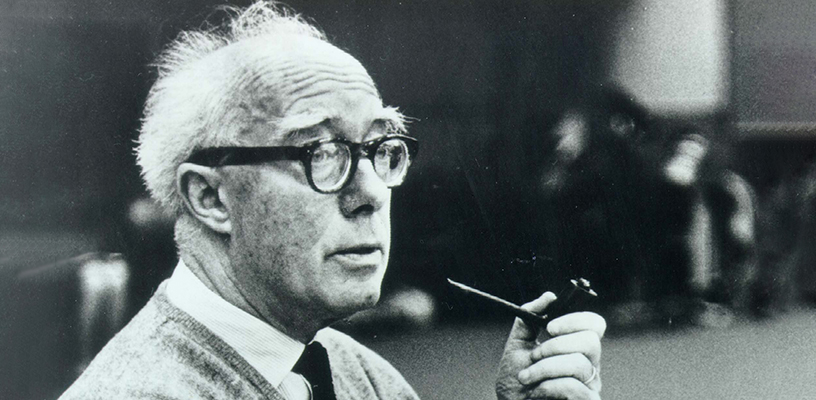
The London Symphony Orchestra under Simon Rattle tours Roberto Gerhard’s Symphony No.3 ‘Collages’, a pioneering fusion of symphonic and electronic sound, in the UK, France and Luxembourg in May. The conductor has done much to champion Gerhard’s music over the decades, embracing his Spanish-influenced works as well as his late modernist scores.
The music of Roberto Gerhard published by Oxford University Press is promoted here under license by Boosey & Hawkes.
Simon Rattle conducts four performances of Roberto Gerhard’s pioneering Symphony No.3 ‘Collages’ with the London Symphony Orchestra, continuing his association with the Catalan-British composer’s music. Following concerts at the Barbican in London (21 May) and the Bristol Beacon (29 May), conductor and orchestra tour the programme internationally to the Philharmonie de Paris (31 May) and the Philharmonie Luxembourg (1 June).
> Visit the London Symphony Orchestra website
> Performances in London / Bristol / Paris / Luxembourg
Gerhard’s music has been championed by Simon Rattle for over 30 years, with the conductor performing the complete Don Quixote ballet with the City of Birmingham Symphony Orchestra in 1992 at the BBC Proms and in Birmingham, followed by multiple outings for the symphonic suite of Dances from Don Quixote with the London Symphony Orchestra, Berlin Philharmonic and, last month, with the Bavarian Radio Symphony Orchestra in Munich. Rattle programmed Gerhard’s Symphony No.3 ‘Collages’ with the Berlin Philharmonic in 2022, and both Symphony No.3 and Dances from Don Quixote are available on the Berlin Philharmonic’s Digital Concert Hall.
> Watch on the Digital Concert Hall
Roberto Gerhard’s final modernist decade in the 1960s coincided with the establishment of new electronic media, and Symphony No.3 offers a skilful collage of symphonic sound and pre-recorded material on tape. Having worked extensively in the 1950s on incidental music for radio theatre, Gerhard established a small studio at his home in Cambridge and collaborated with the BBC Radiophonic Workshop on the assembly of sound productions. This cutting-edge endeavour culminated in his 1959 recorded music for a radio recitation of Lorca’s Lament for the Death of a Bullfighter.
The following year Gerhard was awarded a Koussevitsky Foundation commission and the resulting work, initially titled Collages, was again created with the assistance of the BBC Radiophonic Workshop. The premiere was given at the Royal Festival Hall in London on 8 February 1961 with the BBC Symphony Orchestra under Rudolf Schwarz and a musician operator for the tape part embedded within the orchestra. A BBC Proms performance followed in 1967, with the original mono tape being remastered into stereo and the work performed with the sound projected through speakers at the back of the orchestra.
Gerhard’s original inspiration for Collages came on an air flight when he witnessed a dramatic sunrise. He described the moment the sun blazed out through a sea of cloud as “the blast of 10,000 trumpets” which is referenced in the trumpet calls of the opening. The work plays continuously for 20 minutes but is built from seven sections, each referring to a phase of the day, assembled as a sequence of Laudes. This structure evolved from Gerhard’s first idea of the work being a song of praise, quoting a verse from Psalm 113: “From the rising of the sun unto the going down of the same the Lord’s name be praised”.
The soundworld in Symphony No.3 is highly characteristic of Gerhard’s late style with its shattered material and vivid flashes of colour, and the occasional coalescing of ostinati or dances into recollections of distant memories. This shift in style was heralded by his re-engagement in the early 1940s with Schoenberg’s modernist aesthetic when composing his Violin Concerto in honour of his teacher’s 70th birthday. The following years saw Gerhard preoccupied with the completion of two major Hispanic-themed projects, the opera The Duenna and the ballet Don Quixote, and it was not until the 1950s that he transitioned towards his late style through Symphonies Nos.1 and 2. Electric sound and how its colours could be mirrored by the orchestra, provided a final ingredient in the distilled modernist idiom that can be heard in Gerhard’s impressive final decade of compositions until his death in 1970. His decision to allot Collages a place in his symphonic cycle as Symphony No.3 acknowledges the strong underlying musical argument in this work, weaving together the collaged collision between the orchestral and electronic mediums.
> Further information on Symphony No.3 on the OUP website
> Gerhard on the Oxford University Press website
> Gerhard on the Boosey & Hawkes website
Gerhard’s music can be heard on an extensive series of recordings on Chandos, including Symphony No.3 ‘Collages’ with the BBC Symphony Orchestra conducted by Matthias Bamert, dating from 1997 (CHAN 9556).
This month brings a Gerhard musicological lecture series presented by the Robert Gerhard Foundation in collaboration with the Biblioteca de Catalunya, detailing the holdings of the three public institutions that preserve documentation related to Roberto Gerhard. On 13 April Rosa Montalt, Head of the Music Section of the Biblioteca de Catalunya, describes the archive sources dating from Gerhard’s work as librarian and musicologist in Barcelona, and his connections with leading figure in Catalan culture at the time. On 20 April Olga Ger, Project Manager at the Institut d’Estudis Vallencs, details the family collection preserved by Gerhard’s brother Ferran, protected when the composer was driven into exile, and now available for research at the institute in his native town of Valls. On 27 April Anna Pensaert and Richard Andrewes, current and former heads of the Cambridge University Library Music Department, provide context for the collection deposited by the composer’s widow Poldi Feichtegger, including manuscripts, his library, and documents dating from his British period. The three sessions will be shown via livestream on the YouTube channel of the Biblioteca de Catalunya, to be announced here: https://www.youtube.com/user/BibliotecaCatalunya/live.
Photo: Erich Auerbach