





Latin, attrib Jacopone da Todi (c.1230-1306)
Abbreviations (PDF)
Boosey & Hawkes
Commissioned by the Genesis Foundation for Harry Christophers and The Sixteen.
Dedicated to John Studzinski.
I Stabat Mater dolorosa
II Quis non posset contristari
III Sancta Mater, istud agas
IV Fac, ut portem Christi mortem
Music has an infinite ability to tell the same story over and over again. This is part of its tradition but even individual composers can be drawn back to the same models in attempts to reclothe and reinterpret musical forms and structures and settings of classic texts. This is especially the case with the Crucifixion narrative. Bach is revered for his two Passions – St Matthew and St John, but there have been other ways for composers to relate this story in sound.
This text is a 13th century Marian hymn, meditating on the suffering of Mary, the Mother of God as she stands at the foot of the Cross. Stabat Mater Doloroso (The grieving mother stood… at the foot of the Cross) – these are the first words of a long poem, some twenty stanzas in full, whose subject is the Virgin Mary as she beholds her dying Son. For devout Catholics, and the many great composers who set these words, this is a kind of ultimate, spiritual Kindertotenlied. The poem goes beyond mere description and invites the reader and the listener to partake in the Mother’s grief as a path to grace, and as part of a believer’s spiritual journey.
The authorship of the hymn has been variously ascribed to St. Gregory the Great (d. 604), St. Bernard of Clairvaux (d. 1153), Innocent III (d. 1216), St. Bonaventure (d. 1274), Pope John XXII (d. 1334), Gregory XI (d. 1378), but most probably Jacapone da Todi, (d.1306) a Franciscan monk. It is a tricky text to set to music. It is difficult to sustain a persistent tone of pathos, and there are challenging repetitious rhythmic issues in the text. But just as the image has inspired countless painters and sculptors through the centuries it has also attracted generations of wonderful composers.
The great 19th century Swiss theologian Philip Schaff wrote about this poem. In his ‘Literature and Poetry’ he says “The secret of the power of (the Stabat Mater) lies in the intensity of feeling which the poet identifies himself with his theme, and in the soft, plaintive melody of its Latin rhythm and rhyme, which cannot be transferred to any other language.” The usual Protestant objections to the poem’s “Mariolatry” have been muted due to the great beauty and pathos that can touch even the hardest heart. Schaff reminds his readers that that Catholics “do not pray to Mary as the giver of the mercies desired, but only as the interceder, thinking that she is more likely to prevail with her Son than any poor unaided sinner on earth.”
A composer enters into a mysterious collaboration with the word (and The Word) whenever a setting of a text like this is involved. And with the Stabat Mater a composer enters into a particularly painful world of loss, violence and spiritual desolation. I seem to have grown up with the Stabat Mater, singing it as a hymn at school (in the English translation by Edward Caswell) and in the local Catholic parish in Scotland as a boy, and having my early perception of the crucifixion (and indeed the world) coloured by its beauty and sadness. It was a great delight and honour to respond to The Sixteen to write my own Stabat Mater for them.
I do feel as if I'm telling an old story – that many others have been here before me, feeling the tread of history and tradition. But the tragedy keeps resurfacing, from one generation, from one century to the next.
James MacMillan 2016
Choral level of difficulty: Level 4-5 (5 greatest)
John Studzinski’s Genesis Foundation is responsible for some wonderful philanthropic projects, one of the most special being the relationship with Harry Christophers and The Sixteen. They have collaborated frequently and perhaps most notably on Genesis Sixteen, the youth choir associated with the senior group giving opportunities and training to the next generation of young professional consort singers. Like MacMillan, Studzinski is a passionate Catholic and was named Catholic of the Year in 2017 by the Catholic Herald. The Stabat Mater was commissioned by the Genesis Foundation for Harry Christophers and The Sixteen and was premiered with the Britten Sinfonia at the Barbican Hall in London in October 2016.
The work is scored for eight-part choir with soloists from the choir and string orchestra, and the composer views it as a partner piece to his Seven Last Words from the Cross – indeed the Stabat Mater starts from the close of the earlier work. The poem, from the 13th century, is a deeply personal meditation describing the suffering of Jesus’s mother as she stands at the foot of the cross watching her son’s final agony and death. MacMillan digs deep under the surface of this harrowing poem and the result is so deeply personal that it as if we are carried on that journey as witnesses being caught up in the drama and the emotional turmoil. The level of imagination, the unswerving aural acuteness – the variety of textures and effects are simply overwhelming. But perhaps what tells most is that the means of achieving all this never stretches beyond the possible however challenging the work may be overall. As always, the mixture of these means; chant, pure, simple harmony, complex polyphony, extraordinary virtuoso string writing and passages of the richness which seems to pay homage to Vaughan Williams but is MacMillan through and through, permeate the score.
For the choir and orchestra who can undertake this work effectively it will bring untold rewards. It matters little whether those taking part are practising Christians or of no faith, the sheer humanity which pours from these pages cannot fail to move each and every one, as it does the audience who witnesses it. It is notable that the Vatican allowed The Sixteen’s performance of the work as its first live-streaming from the Sistine Chapel gathering a global audience. This is a masterpiece by anyone’s reckoning.
Repertoire Note by Paul Spicer
"MacMillan speaks of a ‘painful world of loss, violence, and spiritual desolation’, and those are the intense feelings packed into his score. Both sides of MacMillan are to be found here, the devotional and the painter of bold, dramatic canvases – the former in the ethereal writing for solo and ensemble voices, the latter in the lacerating blows and feverish anxieties depicted in the string ensemble."
Financial Times
"It’s not often that the composer of a new work gets a standing ovation, but then every new work isn’t like James MacMillan’s Stabat Mater for chorus and string orchestra… The chorus’s plangent cries, carved with a scalpel, might have been expected – but what about the string commentary of stabbing chords, high-speed buzzings, sickening crescendos, growls and whispers?... from noble lament through fury and shriek to contemplative devotion."
The Times
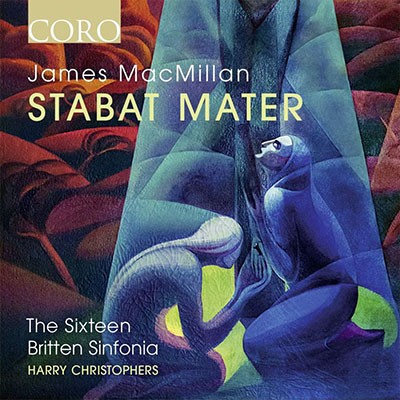
The Sixteen/Britten Sinfonia/Harry Christophers
Coro COR16150