






Symphony No. 3 in E flat major 'The First of May'
op. 20 (1929)Semyon Kirsanov (R)
3(III=picc).2.2.2-4.2.3.1-timp.perc:bells/tgl/SD/BD/cyms/tam-t/glsp/xyl-strings
Abbreviations (PDF)
VAAP
Like the Second Symphony op.14, the Third is on the face of it an avantgarde and experimental work. It is formally similar too, cast in a single movement consisting of a long and colourfully varied orchestral introduction which eventually culminates in a triumphant chorus, singing the praise of the revolutionary festival holiday of the First of May. But this surface similarity is also deceptive, for the Third is strikingly different from the Second. Underneath the gaudy atmosphere of official Soviet celebration and the many different experimental orchestral textures, this symphony has a notably darker feel than its predecessor, with longer and more haunting melodies, strange ghosts of distant marches and eerie passages of orchestral development that are more truly symphonic than anything in the Second and look forward to the more familiar language of Shostakovich’s later symphonies.
The key break-through in the Third seems to have been the young composer’s passionate re-engagement with the symphonies of Mahler, and his increasing desire to move away from idea of being shocking and experimental for the sake of it and instead to confront the problem of how to construct genuinely symphonic music on a large scale.
Because it is so rarely performed, the Third has a reputation for being the neglected Cinderella of Shostakovich’s 15 symphonies. Certainly it is a transitional work, but it is nonetheless fascinating and important for that. It is a key part of our understanding of how the composer made his way from the early triumph of the First Symphony to the mighty Fourth and Fifth. And it is a remarkable and often deeply felt work in its own right.
Note by Gerard McBurney
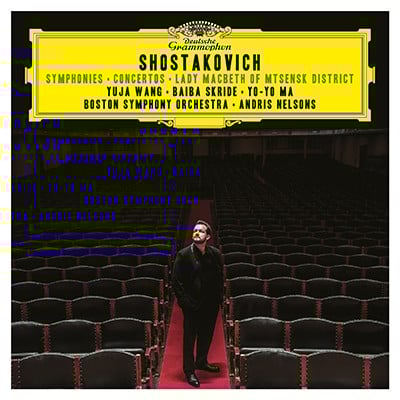
Boston Symphony Orchestra / Tanglewood Festival Chorus / Andris Nelsons
DG 4866649