





OPERA SEARCH

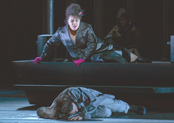
Eurydice - Die Liebenden, blind
(2021)Libretto by Manfred Trojahn (G)
S,M,2Bar; 8 madrigal soloists(SSAATTBB);
3(III=picc,afl).2.corA.2.bcl.dbcl.2.dbn-4.3.3.1-timp.perc(3)-2harp-pft-strings
Abbreviations (PDF)
Bote & Bock
Dutch National Opera, Amsterdam
Pierre Audi, director
Conductor: Erik Nielsen
Company: Andrè Schuen (Orpheus) /Julia Kleiter (Eurydice) / Thomas Oliemans (Pluto) / Katia Ledoux (Proserpin
| EURYDICE | Soprano |
| PROSERPINE | Mezzo-soprano |
| ORPHÉE | Baritone |
| PLUTON | Baritone |
| 8 Madrigal soloists | SSAATTBB |
On a moving train: when their eyes meet, Orphée and Eurydice fall in love at first sight. Orphée is a young artist in search of his path in life, while Eurydice is a woman with a past. She has experienced love, suffered loss, and now yearns for Pluto the god of death in the underworld.
During the irreversible journey into death, Eurydice is constantly haunted by her past and visited by her former lovers. Thus, the budding love between Orphée and Eurydice is repeatedly disrupted by the intervention of another. However, in reality it is always Pluto who visits them in various guises.
The train approaches its destination and then transforms into a boat with Pluto at the helm. He leads Eurydice into the underworld. Orpheus decides to follow Eurydice, but in the world between life and death he first encounters Proserpina – she tries to convince him not to take Eurydice back, but Orpheus does not want to let Eurydice go.
The two lovers meet again in the underworld. Orpheus offers her the chance to return with him to the world of the living, but Eurydice makes a different decision.
An opera about an old theme, but then again not, because it focuses on the moment when Orphée and Eurydice get to know each other, and getting to know each other becomes an often disturbed, painful and quite hesitant process.
Only at the moment when Eurydice dies does Orphée become aware of his love. A piece in which poetry with its ambiguity is more essential than dramatic explosion. A piece that lives from allusions, in which the quiet change of color remains the essential element.
The dismaying realization that death cannot be undone, that we can only live life because the idea of death is not possible for us, leads Eurydice and Orphée to a farewell in melancholy.
Life must be lived "now," in the moment. Past and future are empty projections.
Manfred Trojahn
Tragic