





OPERA SEARCH

Brett Dean’s Of One Blood successfully staged in Munich
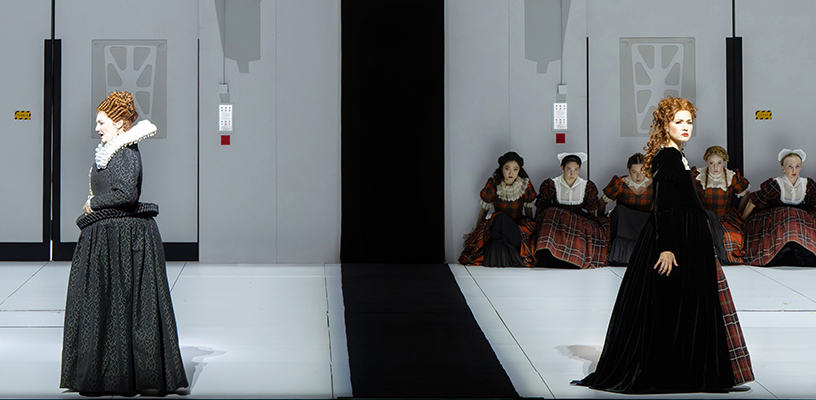
Of One Blood, the new opera by Brett Dean, was premiered to acclaim at the Bavarian State Opera in May, with future performances scheduled at Santa Fe Opera, State Opera South Australia, and Garsington Opera in the UK. Telling of the rivalry between Elizabeth I and Mary Queen of Scots, the opera was staged in Munich by Claus Guth with Vladimir Jurowski conducting.
Following his operatic adaptations of Peter Carey’s Bliss and Shakespeare’s Hamlet, Brett Dean has turned to intrigues at the Tudor court for his third opera, Of One Blood, premiered in Munich in May in a staging by Claus Guth. The Financial Times reviewer described it as “a remarkable achievement for the 64-year-old composer, a coup for the Bayerische Staatsoper and a thrilling addition to the 21st century opera repertoire. It deserves to be heard widely.” Future life for the opera looks assured with further dates already scheduled in Munich next season after the successful opening run, together with performances planned by co-commissioning companies Santa Fe Opera, State Opera South Australia, and at Garsington Opera in the UK featuring a second staging by Louisa Muller.
The opera’s title refers to the close blood relationship between Queen Elizabeth I of England and Mary Queen of Scots, though the two cousins were never to meet in life. Librettist Heather Betts has assembled letters and historical documents which detail the rivalry between the monarchs, leading inexorably to Mary’s imprisonment, trial and execution in 1587. The cast in Munich featured Johanni van Oostrum and Vera-Lotte Boecker as Elizabeth and Mary, and Vladimir Jurowski at the helm of Bavarian State Opera forces. Jurowski had already conducted Dean’s previous opera Hamlet at Glyndebourne and in Munich and championed the composer’s orchestral works in London, Berlin, Munich and Moscow.
“Of One Blood is a resounding success… a Tudor opera about the rival, blood-related queens Mary Stuart and Elizabeth I. But no longer as a drama of jealousy, as in Donizetti’s Maria Stuarda based on Schiller, but rather as a semi-documentary social portrait of two powerful women in a male-dominated form of state and government… the sound of a quill on parchment sets the music in motion and, in the first act, gives way to the restless rhythmic pulse that characterises Dean’s hyper-dramatic music… he writes new music that makes you want to listen. Moreover, it is so tactile – Jurowski calls it ‘muscular’ – that one can scarcely resist it.”
Frankfurter Allgemeine Zeitung
“…an exciting evening at the opera… Dean knows how a large orchestra works and what it is capable of. And he knows how to use these possibilities – and sometimes push them to the limit – to achieve maximum emotional impact. Added to this, in the finest moments, are wit and ingenuity… It’s all thrilling and gripping; the electric surround sound, at times whispering, at times tormenting the nerve endings, contributes to this… The opera consists of two parts, each 70 minutes long; the first is the glittering one, the second its night-dark shadow, set entirely in the prison where Mary Stuart spent 19 years of her life.”
Süddeutscher Zeitung
“The exposition is swift and clean. Dean immediately establishes the queens’ characters through contrasting voice types and temperaments: a dramatic soprano for Elizabeth; a lyric coloratura soprano for Mary… Dean surrounds each queen with a five-person vocal consort (ladies-in-waiting for Mary; scheming lords for Elizabeth) to evoke the English and Scottish courts… The dense, propulsive score is by turns pungent and lyrical. There are references to courtly dances, madrigals, and Elizabethan keyboard music — an onstage harpsichordist, Mahan Esfahani, plays from John Bull’s Walsingham Variations — but, for the most part, this is thorny, bracingly contemporary music with remarkable sweep, momentum and, perhaps above all, conviction.”
Financial Times
“…the opera focuses on mechanisms of mistrust, intrigue and political manipulation. The fact that Heather Betts’ libretto does not present a straightforward perpetrator-victim narrative, but rather depicts the tragic entanglements of two women who are actually close to one another, is a very clever, contemporary perspective. Guth responds to this with a staging that, rather than presenting a self-contained historical tableau, depicts a richly detailed contemporary examination of power, memory and political mechanisms. Fittingly, this includes an imagined meeting space between the queens, who never actually met in history. Outstanding are the vocal and acting performances of the two protagonists, who master their extremely demanding vocal lines with bravura. Johanni van Oostrum portrays Elizabeth with an impressive stage presence, oscillating between a cool, regal demeanour and inner doubts. Vera-Lotte Boecker portrays Mary Stuart with great authenticity, ranging from a naive young girl to a composed woman on the eve of her execution.”
Orpheus Magazine
Coming months bring two new Dean works featuring soprano and orchestra. His setting of poetry by Carol Ann Duffy, The World’s Wife was commissioned by the BBC Proms with the premiere at the Royal Albert Hall on 29 July, featuring soprano Claire Booth, and the BBC Scottish Symphony Orchestra conducted by Ryan Wigglesworth. Dean’s season-long composer residency with the Berlin Philharmonic is launched on 10 September with the premiere of Conversations with Schumann, featuring soprano Jennifer France under the composer’s baton. Other repertoire highlights in the Berlin residency includes a new orchestral score Phantoms on 11 February conducted by Sakari Oramo and his violin concerto The Lost Art of Letter Writing with soloist Isabelle Faust on 17 June with Alan Gilbert on the rostrum.
> Further information on Work: Of One Blood
Photo: © Monika Rittershaus