






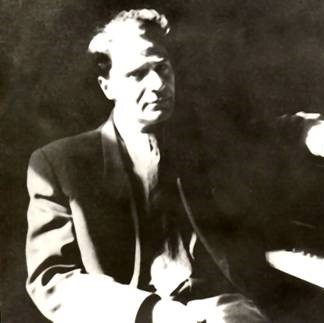
Boris Klusner
d. 21 May 1975, Komarowo
Boris Kljusner was born on 2 June 1909 in the southern Russian city of Astrakhan on the Caspian Sea. After finishing school, he went to Leningrad to study composition with Mikhail Gnessin at the conservatory from 1937 to 1941. There, like Dmitri Shostakovich, who was three years his senior, he developed a special interest in Jewish musical culture. After completing his studies, he remained closely associated with Mikhail Gnessin. He fought in the Red Army from 1941 to 1945 and returned to Vienna after the end of the war. In the meantime, his composition teacher Gnessin, Dmitri Shostakovich and Isaak Dunayevsky had campaigned for him to leave the army and return to Leningrad. In the debate on formalism in Soviet cultural policy that emerged after the war, he took a stand against criticism of Dmitri Shostakovich in particular and came into conflict with the authorities himself. At this time, Kljusner was already on the board of the Leningrad Composers' Association. When he was threatened with imprisonment in 1952, he increasingly withdrew without denying his positions. Nine years later, when the Khrushchev era had long since eased, he resigned from the Composers' Union.
Kljusner wrote symphonies, instrumental concertos such as the particularly charming Concerto for Two Violins and Orchestra, chamber music and film music. Film music was a genre that allowed composers in the Soviet Union a certain degree of freedom at the time, which is why not only Shostakovich and Prokofiev, but also the following generations (including Alfred Schnittke and Sofia Gubaidulina) made significant contributions to it.
Similar to Shostakovich, Kljusner also drew stylistically on Gustav Mahler. His music is characterised by great expressivity and, despite his loyalty to tonality, by no means avoids dissonance.
In his symphonic works in particular, Kljusner sometimes experimented with twelve-tone technique or clusters and was always open to unusual instrumental combinations, including various percussion instruments, the electric guitar or even an organ.
His concerto for two violins and orchestra, dedicated to Johann Sebastian Bach, does not take up baroque compositional structures or refer directly to Bach and his polyphonic compositional art in quotations. It is a completely independent work in Kljusner's very own musical language, which is particularly elegiac in the first movement. And it is an example of Kljusner's brilliant art of orchestration.
In the 1950s and 1960s, Klyusner's works were also recorded on disc by the Leningrad Philharmonic Orchestra under the direction of Yevgeny Mravinsky, among others.
Towards the end of his life, Boris Kljusner withdrew more and more and spent the rest of his life in the beach resort of Komarovo near St. Petersburg, where he died in 1975 at the age of 66, the same year as Shostakovich. Some of his admirers, such as the Russian composers Alexander Wustin and Sergei Slonimski, dedicated special works to his memory. In his work ‘In memoriam Boris Kljusner’, composed in 1977, Wustin set texts by the poet Yuri Olescha, who was banned during Stalin's time, to music. Sergei Slonimski followed in 2000 with a ‘Trio in memoriam Boris Kljusner’.