






Interview: Steve Reich on In All Your Ways
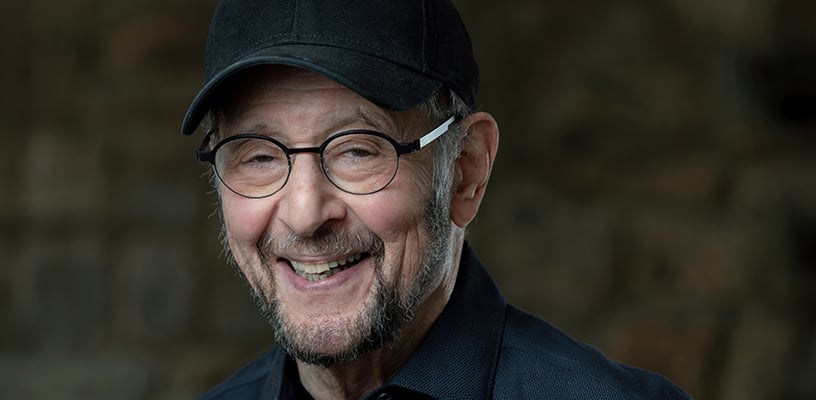
Steve Reich discusses his new work for large ensemble, In All Your Ways, the centerpiece of his 90th-birthday celebrations during the 2026–2027 season. The work receives its world premiere in Edinburgh International Festival with the Colin Currie Group on August 28, then tours to Amsterdam, Toronto, New York, London, Berkeley, Paris, and Los Angeles.
What does the title In All Your Ways refer to?
SR: The title comes from Proverbs 3:6: “In all your ways know Him, and He will straighten your paths.” When I first began thinking about the piece, the phrase “In all your ways" stayed in my mind. In all your ways, your actions, your thoughts—you find yourself.
Colin Currie had asked me to write a new work for large ensemble, and even though I wasn’t writing for singers, I like working with text, so I did it silently. I ended up “setting” the phrase rhythmically: da-da-da-dum. It’s a very flexible rhythmic cell—with a rest in front, it opens Beethoven’s Fifth Symphony—and it recurs throughout this piece, mostly in the fast sections but sometimes in the slow sections, as well. So excuse me, Mendelssohn—it’s my “Song without Words.”
The piece feels unusually varied and changeable. How did you approach its structure?
SR: Usually, movements are separated by changes in tempo. But in recent works, what I’ve been doing is changing note values instead. Let’s say you’re moving fast in 16th notes, and then you go to eighths, and then to quarters—it creates the feeling of getting progressively slower. That became the rhythmic structure of the piece and sections were set up around note values: 16ths, eighths, quarters, and triplets.
Harmonically, there are four key signatures in the piece: three sharps, two flats, five flats, and all naturals. But what they represent can vary—they can be major, minor, or modal. Phrygian mode pops up a lot.
It’s not as strict as many of my previous pieces, where you might say, “First you do this, then you do that, then you repeat the cycle.” Here, it was more: These are the guideposts, these are the possibilities. You can mix and match within each section. It’s musically more interesting to set something up that you can follow, but with more exceptions and unpredictability from note to note. The guideposts kept me organized but gave me a lot of freedom.
There’s much more harmonic movement in this piece than in many of my other works, and more rapid rhythmic movement, as well. It’s very flexible and changeable, but it stays within this large ballpark. Once I realized that was what was happening, it became very enjoyable to work that way.
Your previous two works, Traveler’s Prayer and Jacob’s Ladder, also draw on Biblical texts, but In All Your Ways feels quite different. Do you see the three works as related?
SR: Not at all. This piece stands by itself. It’s a more interesting piece of music—there’s more to chew on. I think particularly the end of my previous work, Jacob’s Ladder, is really beautiful, but overall, it’s a more sedate work. This is a piece that’s very hard to pin down in terms of its overall character because it changes so much. I think that’s one of its virtues.
My wife, Beryl Korot, remarked to me, “This is the work of a younger composer.” And it did cross my mind that this was the kind of thing someone else—someone who had listened to my music and was 30 or 40 years younger—might have done. And I’m glad it was me.
Did that more open-ended approach lead to any unexpected challenges as you were composing?
SR: Most of my pieces take me a long time to get started, and then they more or less go. With this piece, I was constantly revising the basic structure while I was working. I’d never done that before.
I got about three-quarters of the way done and thought, “Stop it. You’re just going fast, fast, fast. Give me a minute to think, will you?” Up until that point, the slowest rhythmic section in the piece was the eighth note, and there was never really a feeling of coming to rest. So, I decided I had to insert sections in quarter notes to really slow things down.
I created these quarter-note sections—three in total—and inserted them into a piece that was already largely composed. I had to change the music leading into and out of them so they would feel at home. It became a puzzle. I’d already done so much, and suddenly I had these extra pieces that I had to fit into it. It’s nice when you’re 89 years old and you’ve written some music to suddenly think, “Hey, I’ve never faced this kind of problem before.”
The slow sections do have a very different, searching quality.
SR: Once I started writing the slow sections, they came very easily. There’s a moment in one of them toward the end of the piece where the music goes down into a lower register—everyone remarks on it. Every time we arrive there, I get a chill. I would call that a gift. Any composing is a gift, but that section is particularly that way.
You’ve described both the title and the music itself as unusually open-ended. Coming back to the title, what does “in all your ways” mean to you?
SR: The important thing is: in all your ways. That’s really where it fits, and I think that’s what it means in Proverbs. In all your ways—when you’re eating dinner, when you’re driving, when you’re having an argument—if you can maintain a mindfulness that life is bigger than you are, that there is a force or a power keeping everything going, including you and me and everybody else, then you have a little more flexibility to keep your sanity and your judgment intact through all the different ways life will take you.
We all encounter unforeseen situations, sometimes pretty frequently, just in day-to-day life. You can’t spell out what “in all your ways” means. There’s no single answer. It’s open-ended. You’re free and you’re responsible.
Inteviewed by Carol Ann Cheung, 2026
> Further information on Work: In All Your Ways
Photo: Jennifer Taylor