





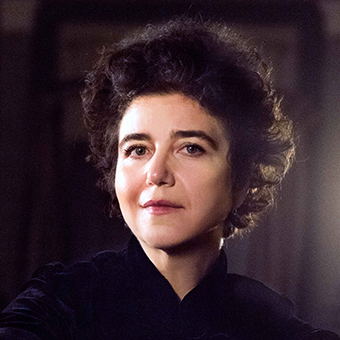
Lera Auerbach
Short Biography (315 words):
Lera Auerbach is an American composer, pianist, conductor, poet, and visual artist. Born in Chelyabinsk in the Ural region of Russia, she moved to New York at seventeen during her first U.S. concert tour, establishing the United States as her artistic home. She studied piano and composition at the Juilliard School and comparative literature at Columbia University, and made her Carnegie Hall debut in 2002 performing her own Suite for violin, piano and string orchestra with Gidon Kremer and Kremerata Baltica.
Auerbach has since established an international career as a composer, pianist, conductor, poet, and visual artist. As a pianist, she has appeared in major concert venues including Carnegie Hall, Lincoln Center, and the Kennedy Center. Her works span all genres—from solo and chamber music to symphonic works, opera, and ballet—and are performed by leading artists and institutions worldwide, including Hilary Hahn and Vadim Gluzman. Her musical language bridges tradition and innovation, embracing both tonal and experimental elements to create a distinctive and highly personal voice.
Among her most widely recognized works is the ballet The Little Mermaid, created in 2005 for choreographer John Neumeier, which has received numerous international awards and performances. Her output frequently draws on literary, philosophical, and mythological themes, as reflected in works such as the choral cycles 72 Angels and Goetia, and her symphonies, which expand and redefine the genre.
In addition to composing, Auerbach is increasingly active as a conductor. She is also an accomplished writer, with publications spanning poetry, prose, and essays, and has been named “Poet of the Year” by the International Pushkin Society. In 2022, her children’s book A is for Oboe (Random House) was published and received the AudioFile Best Audiobook Award. Her multidisciplinary practice extends to visual art, including sculpture.
Auerbach holds both American and Austrian citizenship. Her works are widely recorded on major labels including ECM, Deutsche Grammophon, and Sony Classical.
Long Biography (434 words):
Lera Auerbach is an American composer, pianist, conductor, poet, and visual artist whose work reflects a distinctly cross-disciplinary and international perspective. Born in Chelyabinsk in the Ural region of Russia, she moved to New York at seventeen during her first US concert tour, establishing the United States as her artistic home. She studied piano and composition at the Juilliard School and comparative literature at Columbia University, and made her Carnegie Hall debut in 2002 performing her own Suite for violin, piano and string orchestra with Gidon Kremer and Kremerata Baltica.
Auerbach has since established an international career as a composer, pianist, conductor, poet, and visual artist. As a pianist, she has appeared in major concert venues including Carnegie Hall, Lincoln Center, and the Kennedy Center. Her extensive catalog span all genres—from solo and chamber music to symphonic works, opera, and ballet—and are performed by leading artists and institutions worldwide, including Hilary Hahn and Vadim Gluzman.
Her music is characterized by a highly individual voice that bridges tradition and innovation. Auerbach maintains a fluid relationship with the avant-garde, drawing on tonal language and classical forms while continually expanding their expressive possibilities. Her works frequently engage with literary, philosophical, and mythological themes. These influences shape richly layered works that move fluidly between historical reference and contemporary expression, combining structural rigor with emotional immediacy.
Among her most celebrated works is the ballet The Little Mermaid, created in 2005 for choreographer John Neumeier. The work has toured internationally, received major awards including an ECHO Klassik for its recording, and has been performed hundreds of times worldwide. Other notable works include the choral cycles 72 Angels and Goetia, and a series of symphonies that challenge and expand the genre through their integration of orchestra, choir, and soloists, reflecting her ongoing interest in redefining large-scale musical forms.
In recent years, Auerbach has also appeared frequently as a conductor, bringing her multidisciplinary perspective to the podium. Her literary output includes poetry, prose, and essays, and she has been named “Poet of the Year” by the International Pushkin Society. Her book Excess of Being has been published in English, and in 2022 her children’s book A is for Oboe (Random House) received the AudioFile Best Audiobook Award.
Auerbach is also active as a visual artist, creating sculptures that reflect her interdisciplinary approach and interest in the intersection of artistic forms. She holds both American and Austrian citizenship, the latter awarded in 2021 in recognition of her contributions to music and culture.
Her works are widely recorded on major labels including ECM, Deutsche Grammophon, Nonesuch, Sony Classical, Alpha Classics, and BIS.
This biography can be reproduced free of charge in concert programmes with the following credit: Reprinted by kind permission of Boosey & Hawkes | Sikorski.