







Lucy Walker a cappella choral titles - May 2026
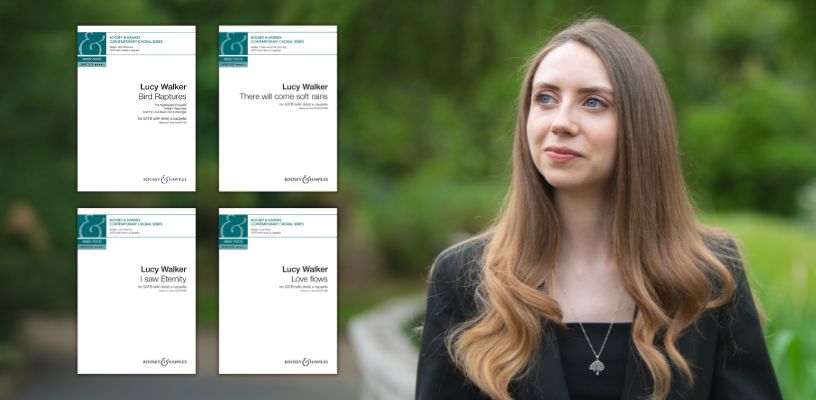
Lucy Walker is an award-winning composer, pianist and music educator from the North East of England, now based in Cambridge. Recognised as one of Classic FM’s Rising Stars in 2024, she is fast gaining acclaim for her vibrant, lyrical choral writing. Discover a selection of Walker’s new sacred and secular repertoire for your upcoming season, all suitable for SATB a cappella choir.
Bird Raptures
Bird Raptures, a trio of pieces for a cappella mixed voiced choir, draws inspiration stylistically from twentieth-century partsong. The Nightingale, setting Christina Rossetti’s poem Bird Raptures, describes the captivating power of a nightingale’s song to connote both sorrow and joy, lulling the listener gently with a lilting metre. In Twilight, Sara Teasdale’s text evokes a deep sense of yearning. Rather than mimicking birdsong, the choir personifies the calling bird with a soaring but melancholy refrain. Overlapping cross-rhythms suggest conversation and tension between the voices, and the tragically inconclusive poetry is reflected by the choral texture fading, unresolved, to a single voice at the song’s close. The innocence and unbridled joy of Coleridge’s Answer to a child’s question provide a light-hearted conclusion to this set. With flamboyant rubato and exaggerated dynamics, the piece builds to a theatrical climax, before drawing the listener into the final line, "And my Love loves me!" in whimsical unison.
I saw Eternity
Setting the opening lines of Henry Vaughan’s The World, I saw Eternity was Walker's first commission as Composer-in-Residence with St Martin’s Voices. Beginning with a gentle, almost tentative melody, the music intensifies, evolving into a shimmering central motif, which explores vivid tonal colours and circling melodies reflecting the text. This builds to a climactic return of the opening line, expansive and glorious in its reiteration, spanning the full range of the voices. The piece draws to a close, and the full texture gradually is distilled, fading to a single pitch – encompassing ‘eternity’ as both an expansive concept and as a singularity of sound. This setting for SATB div a cappella would suit experienced choirs as an anthem or versatile concert piece.
There will come soft rains
Commissioned for Remembrance Day, There will come soft rains (for SATB div a cappella) showcases the range of the choir’s musical colour-palette through the repetition of the opening motif in several guises throughout the piece, from crystalline fragility to radiant strength. The text is profound; Sara Teasdale’s poem (subtitled War time) juxtaposes the tranquil cycle of nature and awakening of Spring against the suffering of mankind, with a simultaneous sense of comfort and unnerving indifference. Musically, this is evoked through a central moment of descent into harsh dissonance, from which the opening melody emerges, seemingly unchanged. Though the piece closes with a light, hopeful sound, there is an unsettling undertone.
Love Flows
Love Flows sets text from 13th-century German mystic, Mechthild of Magdeburg, here in translation by Jane Hirshfield. Reflecting the transcendental atmosphere of the text, this piece explores fluidly shifting, vibrant harmonies, with flowing melodic lines leading to frequent moments of repose on richly-scored held chords. A delicate melodic motif (‘like a bird’) emerges from the opening undulating third texture, and evolves later in the piece into an uplifting, larger-scored reiteration: ‘humanity sings’. Returning at the close of the piece, the motif appears in airy upper-voice solos floating above the choir, representing distant birdsong. This setting for SATB div a cappella would be suitable as a versatile anthem or concert piece for experienced choirs.
Listen to a playlist of choral works by Lucy Walker, published by Boosey & Hawkes:
Photo: Helena Marion Photography